In March of 2015, I came across a series of Facebook posts from the family of a beautiful black-eyed baby girl named Thalia Vida Gardner. Her parents claimed that she had died unexpectedly after a serious adverse reaction to vaccines. They were, via GoFundMe, requesting thousands of dollars to "prove" that her death was a vaccine reaction.
It didn't take me long to find evidence calling those claims into question-- most notably, posts from concerned members of Thalia's family, who pointed out that her diagnosis at her time of death was traumatic brain injury, and that she had opiates in her system.
The entire tragic story is chronicled on the following posts:
Did Vaccines Really Kill Her?
12 Questions About Thalia Vida Gardner's Death
An Open Letter to Karla Gardner
Updates on Thalia Vida Gardner
In the long months that have passed since then, I have not had much of a break from this story. I've been badgered and berated by people asking me why there was no arrest, since many internet users don't seem to understand that an investigation like this can take months or years. Thalia's paternal grandmother has emailed me about once a month, telling me that her son isn't in jail and demanding that I remove screencaps from my blog. Jaci Rizzo-- the grandmother-- has even emailed my friends and relatives demanding that they somehow force me to remove blog posts that speak poorly of her son.
Most painfully, Thalia's story has led to many people personally attacking me and my integrity. Several commenters on previous articles accused me of completely fabricating Thalia's entire story for the purpose of driving traffic to my blog, and a now-widely-circulated "Open Letter to Juniper Russo" claimed that I was being well-paid by pharmaceutical companies to attack a grieving family.
I did none of those things. I have never profited in any way from Thalia's death and have no allegiance to anyone-- or anything-- besides justice. My motive has been, since day one, to see justice served, and to see other innocent children spared painful and horrific deaths.
Until now, I had no answer when people asked me why there was no arrest yet. I am not judge, jury, or law enforcement-- I'm only a concerned citizen who saw vaccines being blamed for what appeared to be a death caused by child abuse. Now, I finally have an answer.
On July 14, 2016, Thalia Vida Gardner's father, Tyler Justin Gardner, was arrested. He was specifically charged with child abuse and neglect with substantial bodily or mental harm-- a felony charge that, in his jurisdiction, carries a sentence of 6-15 years in prison. He is being held on $80,000 bail.
Tyler hasn't been convicted yet and is legally considered innocent until proven guilty. However, if 16 months of thorough investigation revealed child abuse-- rather than a vaccine injury-- I think it's at least safe to say that Thalia's death was not vaccine-related.
I will update readers if and when there is a conviction. In the mean time, I ask that followers stop harassing me and my family, and that everyone keep those who loved Thalia in their thoughts and prayers.
We were sheeple following the tie-dye herd. We believed that nature provided all the answers we needed to raising happy and healthy children. We were wrong, and children are in danger because of parents who, like us, are misled and duped by unchecked "crunchy" culture and irresponsible proponents of alternative medicine. Now dedicated advocates for vaccines and evidence-based parenting, we-- Maranda Dynda, Juniper Russo, and Megan Sandlin-- are on a mission to make a difference.
Showing posts with label vaccines. Show all posts
Poisoned by a Vaccine-- and Assaulted by a Turtle
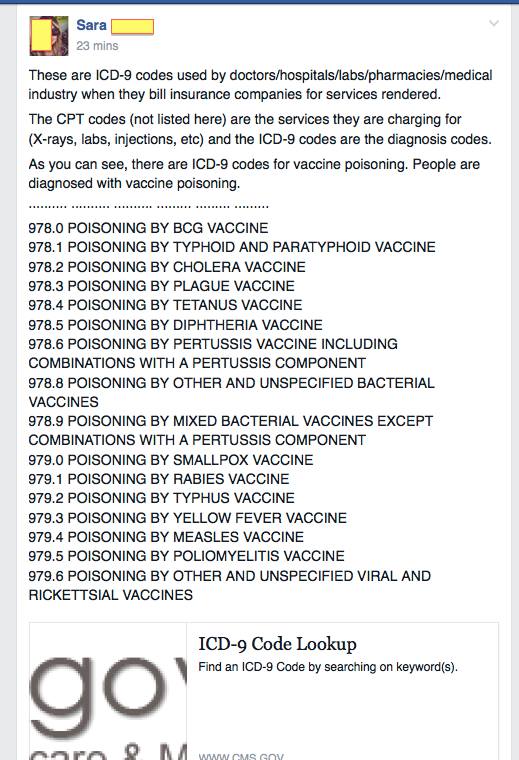
Recently, this list has been making the rounds in anti-vaccine circles, as proof that vaccine-related deaths are real. ICD-9 and ICD-10 codes are part of a standardized system used to facilitate communication between medical experts, researchers, and insurance companies. Anti-vaxxers believe that, because they include poisoning by vaccines, that must mean that vaccine poisoning is a real and common thing.
At first glance, it certainly looks suspicious. Why would insurance companies even have the option of billing for vaccine poisoning, unless it's something that actually happens with some degree of regularity?
In short, the answer is that there are ICD-9 codes for everything. And I mean everything. Not only can you also find poisoning entries for every conceivable medical substance that exists, but the ICD-9 list, which has over 68,000 entries, also includes some pretty bizarre and even inconceivable injuries. Here are a few of my favorites from both ICD-9 and its follow-up version, ICD-10.
974.1: Poisoning by purine derivative diuretics including theobromine
Literally, actually death by chocolate.
V91.07XA: Burn due to water skis on fire, initial encounter
Distinct from its counterpart entry for people who have had subsequent encounters with burning water skis.
T62.0X3: Toxic effects of ingested mushrooms, assault
Not just poisoning from mushrooms, but, y'know... those times when you're assaulted with mushrooms. Or by mushrooms. I'm not sure.
W59.22XD: Struck by a turtle, subsequent encounter
This person hasn't just been hit by a turtle-- not bitten, but struck by a turtle-- but it's happened more than once.
V97.33XD: Sucked into a jet engine, subsequent encounter
The only person in the world with worse luck than the victim of a serial attack-turtle... was apparently sucked into a jet engine and survived long enough to be sucked into another jet engine later on.
W55.29XA: Other contact with a cow, subsequent encounter
"Other" contact with a cow. My brain goes to some strange and disturbing places trying to imagine what gets this entry.
V00.01XD: Pedestrian on foot injured in collision with roller skater, subsequent encounter.
I hate it when I get hit by a roller skater more than once.
X52.XXXA: Prolonged stay in weightless environment.
Well, astronauts need medical care too, right?
V95.45: Spacecraft explosion injuring occupant
Because when a rocket ship explodes, the occupants are definitely going to survive long enough to be treated and billed for their injuries.
W22.0XD: Walked into a lamppost, subsequent encounter
Okay, guys, we all do things when we're drunk or texting, but I think this is something you get a pass for exactly one time. If you're having subsequent collisions with lamp posts, you need help.
Bottom line? Yes, there are insurance code entries for poisoning by vaccines. But that doesn't mean that vaccine poisoning is an epidemic, or even that it has necessarily ever happened. Unless you're also willing to use the ICD-9 and ICD-10 as evidence that our Reptilian Overlords are covering up an epidemic of turtle attacks, it's patently nonsense to use it as evidence of an epidemic of vaccine-related poisoning.
Labels:
anti-vaccine,
diagnosis codes,
evidence-based medicine,
funny,
humor,
ICD-10,
ICD-9,
meme,
vaccines
Juniper Russo's Pro-Vaccine Sermon at UUCC
This is by far the most comprehensive, honest, and complete version of the Back From Nature story. It isn't just about vaccines, but about changing deeply held personal beliefs and finding new truths. I delivered it as a sermon at Unitarian Universalist Church of Chattanooga, where (despite a lot of controversy on social media) it was met with unanimous approval and a standing ovation. Please share the message.Z
Labels:
anti-vaccine,
crunchy culture,
religion,
sermon,
vaccines
My "Normal" Baby's 12-Month Regression
In my former life as an autism-fearing, anti-vax mom, stories like my son's kept me awake at night. I'd pore over all the tales on the internet: "I took my normal baby for his 12-month shots, and the next day, he was autistic."
My son did seem to be typical, by all accounts. Even though my mommy-instinct told me something was different, Early Intervention reassured me after two screenings-- one at six weeks and one at six months-- that he was doing fine. His pediatrician echoed their statements. The consensus was: this is a completely normal baby. Maybe a little wobbly, and on the late side when it comes to crawling and sitting up, but he's fine.
Well, then my "completely normal baby" started nearing his first birthday. He was cruising, standing unsupported, responding to his name, saying a few words. Then, bam: two weeks ago, he stopped being able to stand alone. He stopped cruising. He stopped taking steps. He no longer waved consistently when someone told him to say bye-bye. He stopped answering to his name. He traded his vocabulary of five words for a single one: "Hand," which he started repeating over and over again ad nauseum while looking at a hand.
If this had happened just two weeks later than it did, it would have coincided perfectly with his twelve-month vaccines, which included MMR. But, because it happened before his twelve-month shots, I know with certainty that his developmental regression had nothing to do with his vaccines.
You don't have to take my word for it, though: every major medical establishment in the world agrees that here is no link between immunization and autism. Studies involving a total of millions of children have concluded that vaccines don't increase the risk of autism or worsen autism symptoms in children who are predisposed. Vaccines do, however, coincide with the times when the first signs of autism show up: 12 months, 18 months, and two years. It's easy to see how the timing of these regressions and symptoms can look suspicious.
But, just as I know with certainty that my oldest child was autistic before she was vaccinated-- by the mere fact that she was diagnosed with developmental delays before she'd had a single shot-- I know with certainty that my son's developmental regression occurred before he was vaccinated. It further confirms what I've known for a long time, which is that I gave my kids autism through wonderfully unique genes, not through anything in their environment.
My son will be meeting with Early Intervention tomorrow, and once again, I'm struck by how profoundly different my feelings and experiences have been between when my oldest was diagnosed with developmental delays and when my youngest was. As I've written about before, I was naive and impressionable and full of self-blame seven years ago, but now? This is a walk in the park. Where once I felt fear and sadness and apprehension, I now feel nothing but overwhelming love for my children. I'm excited to watch them grow and thrive and become their own beautiful selves.
I can't wait to see what comes next. Parents with neurotypical kids have a fairly good idea of what they're getting. I have the privilege of discovering my kids anew every single day. Their passions become my passions. Their triumphs become my triumphs. I can't wait to guide my second child through whatever help he needs and then celebrate his successes, however small or large. I can't wait to learn what his strengths are and to mold my parenting to fit the ever-changing needs of a child who marches to the beat of a different drummer. I am genuinely excited to be taking this journey with my children, their tiny hands in mine.
Autism acceptance and vaccine advocacy became my life's work after a string of surprising coincidences, so I believe that it's a wonderful act of fate that I was once again blessed with a child who, by his mere existence, is showing the world about the necessity of evidence-based health care and the reality of autism as a heritable genetic condition. It will be a while before I find out for sure if my son really does have autism. It's possible, though not likely, that he will be neurotypical and just had a temporary developmental glitch. But, if he is autistic, I know for sure that it was encoded in his DNA, not a vaccine. I know for sure that he is not broken, but a beautiful and perfect human being made exactly the way nature intended him.
My son did seem to be typical, by all accounts. Even though my mommy-instinct told me something was different, Early Intervention reassured me after two screenings-- one at six weeks and one at six months-- that he was doing fine. His pediatrician echoed their statements. The consensus was: this is a completely normal baby. Maybe a little wobbly, and on the late side when it comes to crawling and sitting up, but he's fine.
Well, then my "completely normal baby" started nearing his first birthday. He was cruising, standing unsupported, responding to his name, saying a few words. Then, bam: two weeks ago, he stopped being able to stand alone. He stopped cruising. He stopped taking steps. He no longer waved consistently when someone told him to say bye-bye. He stopped answering to his name. He traded his vocabulary of five words for a single one: "Hand," which he started repeating over and over again ad nauseum while looking at a hand.
If this had happened just two weeks later than it did, it would have coincided perfectly with his twelve-month vaccines, which included MMR. But, because it happened before his twelve-month shots, I know with certainty that his developmental regression had nothing to do with his vaccines.
You don't have to take my word for it, though: every major medical establishment in the world agrees that here is no link between immunization and autism. Studies involving a total of millions of children have concluded that vaccines don't increase the risk of autism or worsen autism symptoms in children who are predisposed. Vaccines do, however, coincide with the times when the first signs of autism show up: 12 months, 18 months, and two years. It's easy to see how the timing of these regressions and symptoms can look suspicious.
But, just as I know with certainty that my oldest child was autistic before she was vaccinated-- by the mere fact that she was diagnosed with developmental delays before she'd had a single shot-- I know with certainty that my son's developmental regression occurred before he was vaccinated. It further confirms what I've known for a long time, which is that I gave my kids autism through wonderfully unique genes, not through anything in their environment.
My son will be meeting with Early Intervention tomorrow, and once again, I'm struck by how profoundly different my feelings and experiences have been between when my oldest was diagnosed with developmental delays and when my youngest was. As I've written about before, I was naive and impressionable and full of self-blame seven years ago, but now? This is a walk in the park. Where once I felt fear and sadness and apprehension, I now feel nothing but overwhelming love for my children. I'm excited to watch them grow and thrive and become their own beautiful selves.
I can't wait to see what comes next. Parents with neurotypical kids have a fairly good idea of what they're getting. I have the privilege of discovering my kids anew every single day. Their passions become my passions. Their triumphs become my triumphs. I can't wait to guide my second child through whatever help he needs and then celebrate his successes, however small or large. I can't wait to learn what his strengths are and to mold my parenting to fit the ever-changing needs of a child who marches to the beat of a different drummer. I am genuinely excited to be taking this journey with my children, their tiny hands in mine.
Autism acceptance and vaccine advocacy became my life's work after a string of surprising coincidences, so I believe that it's a wonderful act of fate that I was once again blessed with a child who, by his mere existence, is showing the world about the necessity of evidence-based health care and the reality of autism as a heritable genetic condition. It will be a while before I find out for sure if my son really does have autism. It's possible, though not likely, that he will be neurotypical and just had a temporary developmental glitch. But, if he is autistic, I know for sure that it was encoded in his DNA, not a vaccine. I know for sure that he is not broken, but a beautiful and perfect human being made exactly the way nature intended him.
Labels:
12 months,
autism,
babies,
child development,
genetics,
regression,
toddlers,
vaccines
5 Reasons Feminists Should Vaccinate
Ravishly recently published a piece by feminist anti-vax author Jody Allard, who-- in a string of convoluted drivel-- claimed that opposing vaccines is a feminist thing to do, and that mandatory vaccination is incompatible with feminism. As a vaccine advocate and a feminist: I call bullshit.
Allard is right about one thing. Vaccination is a feminist issue. Immunization is one of the key elements that allows the progression of women's
rights.Although science has noted that feminism has been an influence on the anti-vax movement, it's critical to realize that many of the greatest wins of feminism have relied on immunization. Here's how.
1. Vaccines save women's lives.
Sure, they save the lives of men and children, too, but one of the most successful (and controversial) vaccines in modern history was designed with the specific intent of protecting women. HPV vaccination can prevent over two-thirds of cases of cervical cancer, which is one of the most common forms of cancer affecting women. The efficacy of the HPV vaccine will depend on herd immunity, and it is distinctly unfeminist to jeopardize the lives of women and girls by failing to have yourself and your own children vaccinated.
2. Vaccines provide reproductive freedom.
Deaths from cervical cancer are fairly rare in the industrialized world, but hysterectomies and cervix-damaging surgeries are not. In the past, countless women lost their fertility because of cervical cancer. We spent decades fighting for our right to choose when and whether we become pregnant. Feminism was the driving force behind birth control, abortion rights, emergency contraception, IVF, fertility treatments, and surrogacy, and it should be the driving force behind compliance with fertility-saving immunization.
3. Vaccines enable sexual liberation.
Although the majority of women are exposed to HPV at some point, women who have symptoms are still heavily stigmatized because of the notion that only "sluts" or dirty people can contract sexually transmitted disease. The HPV vaccine, which prevents genital warts in addition to cancer, allows women who have been exposed to the virus to continue their lives without shame and stigma. In addition, other vaccines that protect against sexually transmitted illness-- including the Hepatitis A and Hepatitis B vaccines-- can offer similar peace of mind and safety. Vaccination is part of safe sex, and safe sex is a cornerstone of feminism.
4. Vaccines protect women's dignity.
Preventative medicine for women can be upsetting, degrading, and even sometimes traumatizing. No one enjoys being drilled about her sexual history and then being poked with a cold speculum and having her cervix scraped. Feelings of embarrassment are actually among the leading causes of avoidance of preventative care. While at-risk women still need pap smears, the National Cancer Institute notes that immunization can reduce the need for invasive examinations and tests.
5. Vaccines facilitate workplace equality.
This is likely the most important way that immunization protects women's rights. In a world without vaccines, women's rights suffer. I've written before about the way dedication to "natural" parenting can hurt women's rights, but it goes beyond the failures of "crunchy" culture. Without vaccines, schools and daycares are unsafe. Immunocomprimised children can't attend them. Illnesses like rotavirus and chickenpox spread like wildfire. And, as a glance at any of your local crunchy groups will show, it's not the fathers who stay home and take care of the children in these situations. It's the mothers, many of whom wish that they had careers outside the home, but who are bound in their kitchens, making breast milk yogurt to soothe rotavirus-infected tummies. We can not have workplace equality if our children are not kept safe and healthy through modern medicine.
Vaccines are not an enemy to feminism. They are a necessary ingredient in the ongoing advancement of women's rights. If you care about the rights of women and girls, care about them enough to protect them: vaccinate.
Allard is right about one thing. Vaccination is a feminist issue. Immunization is one of the key elements that allows the progression of women's
rights.Although science has noted that feminism has been an influence on the anti-vax movement, it's critical to realize that many of the greatest wins of feminism have relied on immunization. Here's how.1. Vaccines save women's lives.
Sure, they save the lives of men and children, too, but one of the most successful (and controversial) vaccines in modern history was designed with the specific intent of protecting women. HPV vaccination can prevent over two-thirds of cases of cervical cancer, which is one of the most common forms of cancer affecting women. The efficacy of the HPV vaccine will depend on herd immunity, and it is distinctly unfeminist to jeopardize the lives of women and girls by failing to have yourself and your own children vaccinated.
2. Vaccines provide reproductive freedom.
Deaths from cervical cancer are fairly rare in the industrialized world, but hysterectomies and cervix-damaging surgeries are not. In the past, countless women lost their fertility because of cervical cancer. We spent decades fighting for our right to choose when and whether we become pregnant. Feminism was the driving force behind birth control, abortion rights, emergency contraception, IVF, fertility treatments, and surrogacy, and it should be the driving force behind compliance with fertility-saving immunization.
3. Vaccines enable sexual liberation.
Although the majority of women are exposed to HPV at some point, women who have symptoms are still heavily stigmatized because of the notion that only "sluts" or dirty people can contract sexually transmitted disease. The HPV vaccine, which prevents genital warts in addition to cancer, allows women who have been exposed to the virus to continue their lives without shame and stigma. In addition, other vaccines that protect against sexually transmitted illness-- including the Hepatitis A and Hepatitis B vaccines-- can offer similar peace of mind and safety. Vaccination is part of safe sex, and safe sex is a cornerstone of feminism.
4. Vaccines protect women's dignity.
Preventative medicine for women can be upsetting, degrading, and even sometimes traumatizing. No one enjoys being drilled about her sexual history and then being poked with a cold speculum and having her cervix scraped. Feelings of embarrassment are actually among the leading causes of avoidance of preventative care. While at-risk women still need pap smears, the National Cancer Institute notes that immunization can reduce the need for invasive examinations and tests.
5. Vaccines facilitate workplace equality.
This is likely the most important way that immunization protects women's rights. In a world without vaccines, women's rights suffer. I've written before about the way dedication to "natural" parenting can hurt women's rights, but it goes beyond the failures of "crunchy" culture. Without vaccines, schools and daycares are unsafe. Immunocomprimised children can't attend them. Illnesses like rotavirus and chickenpox spread like wildfire. And, as a glance at any of your local crunchy groups will show, it's not the fathers who stay home and take care of the children in these situations. It's the mothers, many of whom wish that they had careers outside the home, but who are bound in their kitchens, making breast milk yogurt to soothe rotavirus-infected tummies. We can not have workplace equality if our children are not kept safe and healthy through modern medicine.
Vaccines are not an enemy to feminism. They are a necessary ingredient in the ongoing advancement of women's rights. If you care about the rights of women and girls, care about them enough to protect them: vaccinate.
Labels:
cervical cancer,
crunchy culture,
feminism,
gardasil,
HPV,
vaccines
How Anti-Vaxxers Caused the Mexican "Vaccine Deaths"
In May of 2015, two babies died and thirty-one were sickened after receiving vaccines for tuberculosis, hepatitis B, and rotavirus in the tiny Mexican village of La Pimienta. Four remain in serious condition. Tragedies like these are unnerving and devastating. The three viruses were spreading through impoverished rural villages like wildfire, and of course parents were willing to do anything and everything to prevent their children from being victims. How horrible, to think that something that was supposed to save lives ended up claiming them.
The most chilling reality of this situation is that the people who were most vocally upset by these deaths-- wealthy anti-vaccine activists in the United States, where deaths from tuberculosis and rotavirus are rare-- are actually the exact same people who were responsible for their deaths to begin with.
On May 12, Mexican authorities revealed that the babies sickened by the vaccine trio suffered from bacterial infections caused by contamination. Bacteria present in the multi-dose vials caused localized infections that, in some cases, led to sepsis and death. Although Mexico hasn't revealed the exact nature of the contaminants, or whether they were present during manufacturing or seeped into the vials later, the fact remains: these babies would most likely still be alive and healthy if it weren't for the anti-vaccine movement.
You see, science and history had already warned us that this is a risk of vaccination. Just as foods can get contaminated, so can vaccines. In the U.S. alone, 48 million are sickened, 128,000 are hospitalized, and 3,000 die every single year from contaminated foods. And in 1928, a horrible tragedy occurred when a group of youngsters were immunized for diphtheria, a disease with a 1 in 5 death rate for kids in the dark world before vaccines. Forty-two received shots from one vial, and of these unfortunate children, twelve died. Their cause of death was determined to be a staph infection acquired from the contaminated vaccine.
But there was a solution. We didn't have to abandon these life-saving immunizations because of a contaminant. In 1968, the U.S. Code for Federal Regulations mandated that all vaccines in multi-dose vials contain preservatives to prevent the growth of mold and bacteria.
One specific compound seemed like the best option. Thimerosal, which had been introduced forty years prior, had a long-standing history of safe and effective use as a preservative. Unlike antibiotic preservatives, it was hypoallergic. It was also affordable and extremely effective, killing a massive variety of bacteria and fungi that might otherwise contaminate vaccines. Even better, it didn't weaken the effectiveness of the vaccines themselves, as many preservatives do. And it was safe. Animal tests and clinical trials showed that, in the amounts used in medicine, it was nontoxic: when injected into both humans and animals, the worst reaction recorded was localized swelling.
Thimerosal is about 50% mercury by weight, which, at first glance, might sound terrifying. But consider, also, that table salt is made of sodium combined with chlorine, which by itself would be acutely toxic. A compound can contain a poisonous element and yet, itself, be safe. When metabolized by the body, thimerosal turns into thiosaicylate (which is harmless, despite the scary-sounding name) and ethylmercury, which an organic mercury compound considered safe.
Wakefield was a doctor-- keyword here being "was," since he is no longer a licensed medical professional-- who was trying to patent three separate vaccines for measles, mumps, and rubella, which had historically been combined into one safe and effective vaccine. He published a sketchy study in 1998 suggesting that the combination of the three vaccines, when given at once, somehow triggered a chain reaction of bowel disease that led to developmental regression in the form of autism.
Wakefield's study was fraudulent. To date, there have been 107 studies involving millions upon millions of children, finding absolutely no link between the MMR vaccine and autism. But that didn't stop Wakefield's study from having an effect. Parents, panicked by mis-reporting in the media and an apparent autism epidemic, began refusing vaccines. Specifically, they refused vaccines that contained life-saving thimerosal preservatives, mistaking thimerosal for neurotoxic mercury compounds and incorrectly blaming it for autism.
Today, no routinely recommended vaccines for children under six years of age contain thimerosal, with the exception of the live flu vaccine. That did absolutely nothing to slow the tide of vaccine refusal or the increasing rates of diagnosed autism. Rates of autism increased after thimerosal was removed from vaccines... and so did rates of vaccine contamination.
Without thimerosal as a preservative, vaccines given in multi-dose vials run the risk of contamination. And, unfortunately, there is no cost-effective way to immunize children in poor, rural regions without using multi-dose vials. Yet, because of one doctor's elaborate case of fraud, and because of the panic of his anti-vaccine followers, it is no longer included in the vaccines that need it most. Children have died as a result.
The Mexican "vaccine deaths" have been the target of mass fury from the anti-vax crowd. Some conspiracy theorists have gone so far as to speculate that the inoculations were given as part of a "depopulation" effort to reduce the number of children living in Mexico. Others have claimed media cover-up (despite wide reporting by all facets of international media). Others have attacked vaccine activists such as myself, asking if we've changed our minds now that there's an obvious case of children dying from vaccines.
I haven't changed my mind. Vaccines save lives. And the blood of those children isn't on my hands. It's on theirs.
Thimerosal is about 50% mercury by weight, which, at first glance, might sound terrifying. But consider, also, that table salt is made of sodium combined with chlorine, which by itself would be acutely toxic. A compound can contain a poisonous element and yet, itself, be safe. When metabolized by the body, thimerosal turns into thiosaicylate (which is harmless, despite the scary-sounding name) and ethylmercury, which an organic mercury compound considered safe.
Ethylmercury is completely separate from, and far safer than, methylmercury, which is a neurotoxic compound with a similar-sounding name. Methylmercury, the "bad" kind of mercury, is found in things we're exposed to every day, including seafood and light bulbs, yet we survive this exposure with few ill effects. Its far safer counterpart, ethylmercury, can be consumed and injected in quantities much larger without any problems. In fact, science showed again and again that thimerosal-- and the compounds it breaks down into-- doesn't harm humans at any stage in development. Even fetuses, who can suffer brain damage from Mom eating too much tuna, can be exposed to thimerosal without any problem.
For decades, thimerosal saved lives. It allowed children to be given vaccines in multi-dose vials, making them affordable even to the poorest people in the poorest regions, without the risk of contamination. The human life expectancy in countries with high vaccination rates increased by nearly 50% in just a few short decades.
Then came Andrew Wakefield.
For decades, thimerosal saved lives. It allowed children to be given vaccines in multi-dose vials, making them affordable even to the poorest people in the poorest regions, without the risk of contamination. The human life expectancy in countries with high vaccination rates increased by nearly 50% in just a few short decades.
Then came Andrew Wakefield.
Wakefield was a doctor-- keyword here being "was," since he is no longer a licensed medical professional-- who was trying to patent three separate vaccines for measles, mumps, and rubella, which had historically been combined into one safe and effective vaccine. He published a sketchy study in 1998 suggesting that the combination of the three vaccines, when given at once, somehow triggered a chain reaction of bowel disease that led to developmental regression in the form of autism.
Wakefield's study was fraudulent. To date, there have been 107 studies involving millions upon millions of children, finding absolutely no link between the MMR vaccine and autism. But that didn't stop Wakefield's study from having an effect. Parents, panicked by mis-reporting in the media and an apparent autism epidemic, began refusing vaccines. Specifically, they refused vaccines that contained life-saving thimerosal preservatives, mistaking thimerosal for neurotoxic mercury compounds and incorrectly blaming it for autism.
Today, no routinely recommended vaccines for children under six years of age contain thimerosal, with the exception of the live flu vaccine. That did absolutely nothing to slow the tide of vaccine refusal or the increasing rates of diagnosed autism. Rates of autism increased after thimerosal was removed from vaccines... and so did rates of vaccine contamination.
Without thimerosal as a preservative, vaccines given in multi-dose vials run the risk of contamination. And, unfortunately, there is no cost-effective way to immunize children in poor, rural regions without using multi-dose vials. Yet, because of one doctor's elaborate case of fraud, and because of the panic of his anti-vaccine followers, it is no longer included in the vaccines that need it most. Children have died as a result.
The Mexican "vaccine deaths" have been the target of mass fury from the anti-vax crowd. Some conspiracy theorists have gone so far as to speculate that the inoculations were given as part of a "depopulation" effort to reduce the number of children living in Mexico. Others have claimed media cover-up (despite wide reporting by all facets of international media). Others have attacked vaccine activists such as myself, asking if we've changed our minds now that there's an obvious case of children dying from vaccines.
I haven't changed my mind. Vaccines save lives. And the blood of those children isn't on my hands. It's on theirs.
Labels:
anti-vaccine,
conspiracy theory,
mexico,
thimerosal,
vaccines,
wakefield
Guide for Pediatricians for Talking to Anti-Vaccine Parents
Not everyone can be "converted," unfortunately, and I respect and understand that many pediatricians don't want to bother with anti-vaccine parents. However, unvaccinated children need competent doctors more than anyone, so I have deep respect for pediatricians who are willing to accept them as patients. Don't give up on them, though. Here are ten things that you can say that just might win someone over.
1. "Do you think I want to hurt your child?"
Many anti-vax parents believe that their pediatricians are part of a worldwide conspiracy to cover up rates of vaccine side effects or to cause children to become sick or autistic. Of course, it's a lot harder to believe this conspiracy theory when you have to actually say it out loud to the person you're accusing.
2. "My children are vaccinated, and so am I."
If you had some kind of insider knowledge about vaccines being dangerous-- or a conspiracy to cover up that fact-- you wouldn't have your own kids or yourself immunized. The simple reassurance that you support immunization for your own family can go a long way.
3. "What is your specific concern about vaccines?"
You can explain and refute individual concerns about vaccines if you know what they are. Some parents are worried about autism; others think they're full of aborted fetal tissue. You can accomplish a lot by providing the space for parents to voice their concerns and hear factual answers.
4. "If you don't trust my expertise, why are you here?"
Chances are that this anti-vax parent wouldn't call 911 screaming for a naturopath if their child was seriously injured. And they wouldn't be in your office to begin with if they didn't trust you to have a general sense of expertise about children's health. Ask why vaccines seem to be an exception to their willingness to trust you.
5. "Here's a list of great resources about vaccines."
Many fact-based websites offer refutations to the claims and concerns of sites like Natural News and Mercola. Have a list of reputable websites ready for vaccine-hesitant families. In my experience, vaccine-hesitant parents respond better to personal stories and nonprofits-- like Shot by Shot and Voices for Vaccines-- than to what they perceive as faceless organizations, such as the American Academy of Pediatrics and CDC.
6. "That sure is a cute cloth diaper, and I'm so glad that you plan to breastfeed into toddlerhood!"
Many anti-vaccine parents suffer from persecution complexes and delusions of martyrdom. They believe that they, with their "natural" choices, are condemned and shamed by the mainstream simply because they're different. It's a good idea to reassure an anti-vaccine parent that you don't have a problem with natural living, only with parents who eschew necessary preventative medicine.
7. "I know you love your children."
Anti-vaccine parents are, with very few exceptions, loving parents who have simply been misled by dangerous misinformation. You won't get anywhere by calling them neglectful or implying that they don't care about their children-- that would only further alienate them.
8. "I know you're smart."
It might be hard to grit your teeth and spit this out when you're speaking to a nineteen-year-old mom who thinks her Google research trumps your medical doctorate, but say it anyway. Most parents will feel more comfortable talking to you if they feel like you're speaking to them human-to-human without condescension.
9. "I dedicated my life to taking care of children and I want your baby to be healthy."
It's important to remind parents that you genuinely care about their kids' health and safety. After all, you wouldn't have become a pediatrician i you didn't. It can't hurt to offer a gentle reminder that you share their goal of raising a happy, healthy child.
10. "Let's talk about this again in a few weeks."
Maybe you didn't manage to talk them into vaccines this time, but that doesn't mean you made no progress at all. It might take several appointments before the parent starts to come around-- and, unfortunately, some may never come around at all-- but that doesn't mean that your efforts are wasted. Even if they don't seem like they're listening, they are.
You might not be one of the pediatricians patient enough to wade through all the headaches and facepalming that come with accepting anti-vaccine clients-- much less the risk that one might bring pertussis or measles into your waiting room. However, if you are, your voice can make a world of difference to parents like me. We aren't all lost causes. We're here and we're listening, and children's lives are on the line.
Labels:
anti-vaccine,
guide,
medical professionals,
pediatricians,
vaccines
Lorrin Danielle Kain: A Reason Not to Vaccinate?
Nothing can change or undo what happened to this little girl. Nothing can take away a parent's grief. No statistics about "one in a million" can temper the anger directed at the car seat manufacturer. It was a tragedy. A horrible, deadly, and possibly preventable tragedy, and fury and despair are understandable reactions.
But should the parents be trying to persuade others to never use any car seats, ever again?
This is exactly what happened in the heartbreaking case of Lorrin Danielle Kain, a beautiful little girl who passed away in 2009-- except that it wasn't a car seat. It was a vaccine.
After reading everything I could find about Lorrin and her condition, I have a few nagging doubts about whether Lorrin's condition was genuinely a vaccine reaction. At least a few people have pointed out that Lorrin's symptoms actually match Dravet syndrome, a serious form of epilepsy that has not been linked to immunization. But let's assume that Lorrin suffered and died because of vaccines.
That still isn't a good reason not to vaccinate your kids.
Lorrin suffered because of a bad batch, not because vaccines are fundamentally dangerous. According to Lorrin's mother, Lorrin received a dose from a "hot lot"-- a defective batch of vaccines that caused "seizures or worse" in eleven children who received it. As tragic as it is, defective batches happen in absolutely all kinds of products. Consider, for example, that contaminated foods cause 3,000 deaths per year and go nearly unnoticed. Cantaloupe from a farm that had received "superior" health inspection ratings from multiple third parties killed 33 people in 2011, but I didn't hear anyone say that cantaloupe should be banned. We need both food and medicine to survive. Tragedies like this are reason to call for better safety in food and medicine, not to abandon them entirely. |
Not only has the batch been off the market for over two decades, but so has the entire line of inoculations. The DTP vaccine-- the one that caused Lorrin's reaction-- is not available anymore in the United States. Lorrin's mother and her supporters often conflate the DTP vaccine, which Lorrin received, with the Tdap and DTaP vaccines, which are part of the modern immunization schedule. They're not the same thing, and it's dangerous to treat them like they are. Conflating the Lorrin's vaccine with DTaP is like comparing the inactivated polio vaccine-- which can't possibly cause polio infection-- with the live-virus inoculation, which can. It's a completely different shot with completely different risks, and modern medicine has dramatically reduced the risks associated with many immunizations.
So what's different? The D, T, and P stand for diphtheria, tetanus, and pertussis. All variations of this class of vaccine-- and there are many-- protect against these three serious illnesses. DTP, which was given until the mid-nineties. contained whole cells of the diseases it protected against, and that meant a relatively large number of side effects, mostly in the form of fevers and local swelling. But DTP is a thing of the past, a chapter in medical history books not far from the smallpox vaccine.
The "a"s in DTaP and Tdap, which are given today, stand for acellular, meaning that they contain just a few proteins from the pertussis bacterium. The use of acellular vaccines is a victory for modern medicine: the American Academy of Pediatrics points out that, today, we protect against 11 diseases by exposing kids to just 130 antigens (proteins from germs). Compare that to a hundred years ago, when a single smallpox vaccine contained 200 antigens altogether. As much as parents fear overwhelming the immune system, kids' bodies actually just need to react to a few little pieces of germs in today's schedule.
As a result of these advancements, today's DTaP shots are even less likely than their predecessors to cause serious adverse events. The advent of acellular vaccines means that kids today have about 90% fewer side effects from DTaP than they did from its predecessor twenty years ago. In other words, the vaccine that your baby would get in 2015 is only one-tenth as dangerous as the vaccine that caused Lorrin's reaction in 1994.
Even if we were still using the DTP vaccine that Lorrin received, the risk of a serious adverse reaction would still be infinitesimally small. The World Health Organization reports that serious adverse reactions occurred in only about 1 in 750,000 children who received the vaccine, when it was available. By comparison, diphtheria had a death rate of about 1 in 5. Untreated tetanus kills 1 in 4-- and with excellent treatment might kill as few as 1 in 9 and cause permanent disability in 1 in 3.
That still isn't a good reason not to vaccinate your kids.
Lorrin suffered because of a bad batch, not because vaccines are fundamentally dangerous. According to Lorrin's mother, Lorrin received a dose from a "hot lot"-- a defective batch of vaccines that caused "seizures or worse" in eleven children who received it. As tragic as it is, defective batches happen in absolutely all kinds of products. Consider, for example, that contaminated foods cause 3,000 deaths per year and go nearly unnoticed. Cantaloupe from a farm that had received "superior" health inspection ratings from multiple third parties killed 33 people in 2011, but I didn't hear anyone say that cantaloupe should be banned. We need both food and medicine to survive. Tragedies like this are reason to call for better safety in food and medicine, not to abandon them entirely. |
Not only has the batch been off the market for over two decades, but so has the entire line of inoculations. The DTP vaccine-- the one that caused Lorrin's reaction-- is not available anymore in the United States. Lorrin's mother and her supporters often conflate the DTP vaccine, which Lorrin received, with the Tdap and DTaP vaccines, which are part of the modern immunization schedule. They're not the same thing, and it's dangerous to treat them like they are. Conflating the Lorrin's vaccine with DTaP is like comparing the inactivated polio vaccine-- which can't possibly cause polio infection-- with the live-virus inoculation, which can. It's a completely different shot with completely different risks, and modern medicine has dramatically reduced the risks associated with many immunizations.
So what's different? The D, T, and P stand for diphtheria, tetanus, and pertussis. All variations of this class of vaccine-- and there are many-- protect against these three serious illnesses. DTP, which was given until the mid-nineties. contained whole cells of the diseases it protected against, and that meant a relatively large number of side effects, mostly in the form of fevers and local swelling. But DTP is a thing of the past, a chapter in medical history books not far from the smallpox vaccine.
The "a"s in DTaP and Tdap, which are given today, stand for acellular, meaning that they contain just a few proteins from the pertussis bacterium. The use of acellular vaccines is a victory for modern medicine: the American Academy of Pediatrics points out that, today, we protect against 11 diseases by exposing kids to just 130 antigens (proteins from germs). Compare that to a hundred years ago, when a single smallpox vaccine contained 200 antigens altogether. As much as parents fear overwhelming the immune system, kids' bodies actually just need to react to a few little pieces of germs in today's schedule.
As a result of these advancements, today's DTaP shots are even less likely than their predecessors to cause serious adverse events. The advent of acellular vaccines means that kids today have about 90% fewer side effects from DTaP than they did from its predecessor twenty years ago. In other words, the vaccine that your baby would get in 2015 is only one-tenth as dangerous as the vaccine that caused Lorrin's reaction in 1994.
Even if we were still using the DTP vaccine that Lorrin received, the risk of a serious adverse reaction would still be infinitesimally small. The World Health Organization reports that serious adverse reactions occurred in only about 1 in 750,000 children who received the vaccine, when it was available. By comparison, diphtheria had a death rate of about 1 in 5. Untreated tetanus kills 1 in 4-- and with excellent treatment might kill as few as 1 in 9 and cause permanent disability in 1 in 3.
In developing countries where most moms are unvaccinated and can't pass tetanus immunity to their newborns, tetanus still accounts for nearly 1 in 5 newborn deaths. Pertussis (also known as whooping cough) is the most mild of the three infections, but is still pretty serious: it kills 1 in 50 babies who contract it and lands 2 out of 3 in the hospital. Even when we still relied on the modern DTaP vaccine's whole-cell predecessor, it was still very much worth the risk.
Lorrin's mother found comfort by aligning herself with the anti-vaccine movement and its claims that vaccines cause autism. The anti-vax website Age of Autism regularly features information about Lorrin and her family, and Lorrin's image and story are promoted on autism-related websites and social media pages as evidence of the link between autism and vaccines. This doesn't make much sense to me. Lorrin did not have autism-- it was never, ever part of her diagnosis. She may have developed an adverse reaction to a vaccine, but "I believe the MMR vaccine causes autism because Lorrin Kain developed brain damage from DTP," makes about as much sense as, "I believe that aspirin causes cancer because I heard of someone who died from a penicillin allergy." It is neither the same substance nor the same condition. The people exploiting Lorrin's death to promote their agenda are helping no one.
Statistics don't do much to quell grief. I could never look Lorrin's mother in the eye and tell her, "Your daughter's death was worth it because vaccines save lives."
But I could also never say, "Your child's death was worth it because a defective batch of DTP vaccines hurt someone 21 years ago," to the mothers of Callie Van Tornhout, Brie Romaguera, Brady Alcaide, Landon Dube, or any of the other thousands upon thousands of children who die because of diphtheria, tetanus, and pertussis. I can not justify the abandonment of an entire class of live-saving preventative medications because a tiny number of people have suffered from adverse reactions.
Lorrin's family will always have my deepest sympathies. I believe that no parent should ever lose a child. It is not a pain that I would wish on my worst enemies, and I consider myself lucky every day that my children are healthy and happy. It is because of that-- because of my desire to see children live and thrive-- that I am a vaccine advocate. We can't let extraordinarily rare accidents lead us to abandon a miracle of modern medicine that saves so many new and innocent lives.
But I could also never say, "Your child's death was worth it because a defective batch of DTP vaccines hurt someone 21 years ago," to the mothers of Callie Van Tornhout, Brie Romaguera, Brady Alcaide, Landon Dube, or any of the other thousands upon thousands of children who die because of diphtheria, tetanus, and pertussis. I can not justify the abandonment of an entire class of live-saving preventative medications because a tiny number of people have suffered from adverse reactions.
Lorrin's family will always have my deepest sympathies. I believe that no parent should ever lose a child. It is not a pain that I would wish on my worst enemies, and I consider myself lucky every day that my children are healthy and happy. It is because of that-- because of my desire to see children live and thrive-- that I am a vaccine advocate. We can't let extraordinarily rare accidents lead us to abandon a miracle of modern medicine that saves so many new and innocent lives.
Labels:
anti-vaccine,
autism,
diphtheria,
encephalitis,
epilepsy,
Lorrin Danielle Kain,
pertusiss,
science,
tetanus,
vaccines
Anti-Semitism in the Anti-Vaccine Movement
Antisemitism is rampant in the anti-vaccine community, and it goes a long, long way back. In 1932, an antisemitic magazine published a drawing of a smug-looking Jewish doctor immunizing a baby in a cartoon labeled, "Die Impfung," or "The Vaccination," with a caption reading: "It seems to me that poison and Jews seldom do good things."
We haven't moved much further beyond the early premise that vaccines are poisons concocted by a Jewish conspiracy. It's not a surprise, really: Judaism is the Kevin Bacon of conspiracy theorist culture. You just have to scratch the surface of any conspiracy theory to the Jews who are allegedly behind it. Children missing? Jews stole them and drank their blood. Recession? Must have been the Rothschild family. Problems on Wall Street? Jews did it. Federal Reserve conspiracies? Definitely Jews. Media cover-ups? Jews. Subliminal messages in Hollywood? Jews. 9/11? Jews. Chemtrails? Jews. Vaccines? Jews, of course.
I've encountered it time and time again in my passion for vaccine advocacy. People who might otherwise take me seriously latch on to mentions of my cultural background as evidence that I'm being paid by Big Pharma. After I'd seen a post that said that fellow vaccine advocate Dorit Reiss and I were "buddies," I sent her a message for the first time, introducing myself. I mentioned in passing that her maiden name, Rubinstein, is similar to my stepfather's name, Rubenstein, and said we could be distant relatives. Of course, I couldn't help but quip that we were both part of the Jewish shadow government.

It was literally one day later that I received a message from someone telling me that "Everyone knows your Aunt Dorit is feeding you money to peddle her lies." The day after I encountered fellow Jewish vaccine advocate, she was suddenly my wealthy aunt who was funding my advocacy for vaccines.
This is just the painless surface of antisemitism in the anti-vaccine movement. I've seen how ugly-- and how ridiculous-- it gets. Anti-vaccine activists have told me, you see, that it's my fault that my daughter has autism, because my "Jewish genes" from my "tribe" are full of "mental, physical, etc disabilities due to the years/centuries of inbreeding." (Joke's on them, anyway, since autism rates in Israel are half that of the U.S., and my daughter is culturally but not ethnically Jewish.)
They say that our children get special vaccines. One man, based on kids he's seen staring at him in Walmart, as arrived at the brilliant conclusion that Jews get special vaccines and that all other children get poisonous vaccines.
If this were true, I'm a little upset that I missed the part of Hebrew school where I was supposed to learn the secret handshake to let my pediatrician know that I'm Jewish and that my kids should get the vaccines that don't cause them to stare when an antisemitic stranger is creeping on them in Walmart.
It's all part of a Zionist conspiracy, though-- so they say. These people envision a future dominated by militant Jews with Magen Davids and the words "Zionist" written on their uniforms. This Jew-dominated future police state apparently involves vaccine checkpoints where mothers scream and are restrained as their babies are helplessly injected with lethal chemicals.
And this panic over some future Zionist police state seems to bleed into every single discussion they have with Jewish vaccine activists. They tell us that we are just part of a plot.
...Something to do with the "Judaification of America." And they want us to go back to Russia and East Europe. You know, those places were we were slaughtered by the millions.
But they also want us to go back to Israel. They can't seem to make up their minds.
They call us "cockroach."

They call us communist, and in the same breath, call us fascist. They insult our appearance. They call us "mindless, money-driven, greedy heathens."
My, isn't that familiar.
The scary thing is that, the closer and closer anti-vaccine activists get to utter Nazism, the more they begin to claim that they themselves are victims of a modern Holocaust. They flippantly dismiss the actual horrors of the Holocaust-- the brutal deaths of 6 million innocent people by gas, disease, starvation, and labor-- by comparing their experience of refusing to immunize their kids to the experience of being a Jew in Nazi Germany.
"Their doing the same thing to us that they are they jews," one anti-vaxxer screamed, taking the time to edit her comment to eliminate one of her seventeen grammatical errors.
Meanwhile, one of the most popular articles cries, "First, They Came for The Anti-Vaxxers," a reference to a poignant poem about the Holocaust by Martin Niemoller. It implies that the anti-vaxxers are the "Jews" of today, the first victims in what will become a total Holocaust.
Although it was popular, it wasn't the first or only vaccine/Holocaust comparison to go viral. Amy Barajas, an insufferable schmuck of a mommy-blogger, posted an image of herself in Holocaust Chic, wearing a self-imposed anti-vaccine badge and comparing it to the badges my people wore to the gas chambers. The image spread like wildfire among anti-vaxxers with persecution complexes.
Another anti-vaccine activist compared his resistance to vaccines to August Landmesser's refusal to give a Nazi salute. August Landmesser was tortured for years in concentration camps because of his resistance to the Nazi party and his relationship with his Jewish wife. Anti-vaxxers, on the other hand, have yet to even be denied access to public health insurance and public school. Don't worry, though: he "don't mean to be insulting."
The anti-vaxxers know how much it stings when I, as a Jew, am told that they are victims of a modern Holocaust. They exploit this when speaking to me and my fellow Jewish vaccine advocates:
Anti-vaxxers aren't always hateful people. I know that because I used to be one of them. But I come from a culture that values reason. I was taught as a child that the highest mitzvah, or commandment, is to nurture human life-- that it goes above and beyond any other duty we have to ourselves and others. My background plays a role in my vaccine advocacy not because it's part of a global conspiracy, but because it's a culture that prizes science and human life.
All joking and stereotypes aside, it's not a coincidence that a disproportionate number of Jews are drawn to careers in medicine. It's not (despite what some may say) because it's a well-paid career, but rather, because we tend to value science and its role in improving and strengthening the bodies that we're given. We are commanded not to accept human life as short and brutal, but to use our minds, and the minds of those who came before us, to build a better future.
I'm not a "good" Jew. I've got tattoos on both of my forearms, I'm queer as a ten-cent nickel, and my son's still got his foreskin. I have a Christmas tree and I get my daughter a real birthday cake every year even though her birthday tends to fall during Passover. Plus, I can't stand Benjamin Netanyahu or gefilte fish. But I know I'm at least doing one thing right. I'm standing up for the use of science to prolong and protect the lives of my children and others.
Apparently, all other things aside, my vaccine advocacy combined with my Judaism mean that I am an ugly communist fascist money-grubbing Zionist cockroach shill. My reasons for advocating for vaccines are called into question, my children are labeled the defective products of incest, and my opinion is taken with a grain of antisemitic salt.
The anti-vaxxers are right when they say that today sometimes looks suspiciously like 1932. But I think they're wrong about who among us is actually the target of hate.
Labels:
anti-semitism,
anti-vaccine,
conspiracy theory,
Jews,
Judaism,
Juniper Russo,
religion,
vaccines
My Great-Aunt Died From Diphtheria. This is Her Legacy.
There are no photos of Wilma Dean, but this photo shows the home where she spent her short life. The young man on the far left is her father. The photo was taken about 15 years before her death.
I never met my Great-Aunt Wilma. She died before I was born—long before
I was born, in a time and place when children’s lives were a dime a dozen, when
parents had twelve children in hopes that three might survive. The closest that
I came to her was when I laid flowers on her grave in May of 2012. She sleeps
in a forgotten cemetery among the oaks and hickories of rural Alabama. This is
the last of her short and small legacy.
My grandmother invited me to drive her to her family’s graveyard for “Decoration Day.” It’s an old term for Memorial Day, which was, at least to my grandmother, a day for honoring all the dead, not just veterans. She hadn’t been to her family’s cemetery in years, so my toddler and I accompanied her on the long and lonely drive. We disappeared onto dirt roads. Soon, there was no cell phone reception. Later, no power lines. Eventually, unpaved paths with no names.
“Are you sure you know where we’re going?” I asked.
“I’m sure,” she said.
“What’s this place called?”
“There’s not a name for it. I think they get their mail on the Ragland route.”
We arrived to see a bleak cemetery with mostly un-engraved grave markers, crooked boulders sticking out of the Earth like teeth. The few that had words written on them were misspelled. Some had the names of mothers and babies who were buried together. Some had dilapidated confederate flags on tiny wooden poles in front of them. On a hill, half-choked by weeds, was one small, unassuming tombstone.
“That was my sister Wilma Dean,” my grandmother said, tearing a few weeds away with her gnarled fingers.
“What happened to her?” I asked.
“Diphtheria. She was three.”
I clutched my own daughter’s tiny hand. I was barely, at that point, beginning to realize the error I’d made by eschewing immunizations. I had wanted so desperately to believe that “childhood illnesses” were no big deal and that the world had never been as dark and scary as the history books say. I had wanted to believe that she didn’t need vaccines and that children were safe without them.
“I can’t imagine how upset your parents must have been,” I sighed.
“They weren’t,” my grandmother said with a shrug, “Kids died so often back then, I really think, it was almost like we were just all used to it. They’d buried another baby right before that, and had nearly lost your Aunt Charlsie, too. You know, I can still remember the day she died, better than I can remember last week.”
“What was it like?”
My grandmother looked like she was staring into some place very far away, some place sepia-toned and earthy. A little wooden cabin in the forest. Little girls in cotton sundresses. Mules.
“She got… a real high fever. And swelled up real bad, in the face. Mother and Daddy had a doctor come and see her but I don’t reckon there was anything he could do. Mother was holding her when she died. She was the awfulest color. Daddy thought that she’d caught it from a cat—people was so ignorant back then—and so he shot every single one of our barn cats.”
“Why did he think she got it from a cat?”
“People was ignorant,” she repeated, “And I remember thinking that maybe I was fixin’ to get sick with it, too, and what would happen if Mother and Daddy buried both of us together.”
“How awful.”
“I reckon. But you don’t hear much about diphtheria no more, do you? I think there’s a shot for it now.”
“They say it causes autism,” I said, flinching while I said it. I had to somehow defend my choice not to immunize my daughter. It was too complex of an issue to even begin to explain to someone who knew next to nothing about vaccines, but I still felt a defensive need to say it.
“Autism? What Kelly’s boy across the street has?”
“Yeah. People didn’t have that when you were little, did you?”
“There's always been goofy people," she said plainly, "That ain't nothin' new."
“But autism is different. It’s a vaccine reaction. A lot of people think it is.”
She shrugged, “I’ve seen people get real sick from shots. One time I got a flu shot, and boy did I get sick. But all I know is, I haven’t heard of no one dying from diphtheria in a long time.”
I tried to think of something to say. I was still struggling. I was increasingly aware that my daughter was autistic and increasingly aware that I had made a mistake. Standing in front of the grave of a little girl who died in her mother’s arms of a disease my child would never get, my mistake was that much more painfully apparent. And, as much as I didn't want to know them, I knew the statistics: the DTaP vaccine is highly effective in preventing diphtheria, and without it, diphtheria claims as many as one in five lives.
I lay a flower on her grave and pushed aside the clumps of clay that had mostly buried the marker.
My grandmother rarely criticized me, especially on topics that she thought I knew more about than she did. She only had a seventh-grade education and she regarded most of her knowledge as passé and unimportant. But, as she got into my car, she wasn’t too shy to tell me what she was thinking.
“People… You’re confused, sweetheart. Everybody spends their whole life trying to make the world better for their kids and their grandkids. But not you. You’re trying to go backwards. I’ll never understand it. Things wasn’t good back then. You want to think that they was, but they wasn’t. You’re going to figure that out one day.”
My car got stuck in the mud as we were leaving, and my grandmother commented that it would be hard to come back without four-wheel drive.
“Do you want to be buried there?” I asked when we finally saw pavement and power lines again.
“Lord, no,” she coughed, “I want people to come and visit me. It’s just a matter of time before that place is forgot altogether.”
My aunt, forever three years old, lies in the earth in some graveyard I will probably never see again. When my grandmother passes away, so will the last remaining memory of what Wilma Dean’s face looked like. That will be the very, very end of a life that was too short, in a time and place when life was cheap.
My grandmother invited me to drive her to her family’s graveyard for “Decoration Day.” It’s an old term for Memorial Day, which was, at least to my grandmother, a day for honoring all the dead, not just veterans. She hadn’t been to her family’s cemetery in years, so my toddler and I accompanied her on the long and lonely drive. We disappeared onto dirt roads. Soon, there was no cell phone reception. Later, no power lines. Eventually, unpaved paths with no names.
“Are you sure you know where we’re going?” I asked.
“I’m sure,” she said.
“What’s this place called?”
“There’s not a name for it. I think they get their mail on the Ragland route.”
We arrived to see a bleak cemetery with mostly un-engraved grave markers, crooked boulders sticking out of the Earth like teeth. The few that had words written on them were misspelled. Some had the names of mothers and babies who were buried together. Some had dilapidated confederate flags on tiny wooden poles in front of them. On a hill, half-choked by weeds, was one small, unassuming tombstone.
“That was my sister Wilma Dean,” my grandmother said, tearing a few weeds away with her gnarled fingers.
“What happened to her?” I asked.
“Diphtheria. She was three.”
I clutched my own daughter’s tiny hand. I was barely, at that point, beginning to realize the error I’d made by eschewing immunizations. I had wanted so desperately to believe that “childhood illnesses” were no big deal and that the world had never been as dark and scary as the history books say. I had wanted to believe that she didn’t need vaccines and that children were safe without them.
“I can’t imagine how upset your parents must have been,” I sighed.
“They weren’t,” my grandmother said with a shrug, “Kids died so often back then, I really think, it was almost like we were just all used to it. They’d buried another baby right before that, and had nearly lost your Aunt Charlsie, too. You know, I can still remember the day she died, better than I can remember last week.”
“What was it like?”
My grandmother looked like she was staring into some place very far away, some place sepia-toned and earthy. A little wooden cabin in the forest. Little girls in cotton sundresses. Mules.
“She got… a real high fever. And swelled up real bad, in the face. Mother and Daddy had a doctor come and see her but I don’t reckon there was anything he could do. Mother was holding her when she died. She was the awfulest color. Daddy thought that she’d caught it from a cat—people was so ignorant back then—and so he shot every single one of our barn cats.”
“Why did he think she got it from a cat?”
“People was ignorant,” she repeated, “And I remember thinking that maybe I was fixin’ to get sick with it, too, and what would happen if Mother and Daddy buried both of us together.”
“How awful.”
“I reckon. But you don’t hear much about diphtheria no more, do you? I think there’s a shot for it now.”
“They say it causes autism,” I said, flinching while I said it. I had to somehow defend my choice not to immunize my daughter. It was too complex of an issue to even begin to explain to someone who knew next to nothing about vaccines, but I still felt a defensive need to say it.
“Autism? What Kelly’s boy across the street has?”
“Yeah. People didn’t have that when you were little, did you?”
“There's always been goofy people," she said plainly, "That ain't nothin' new."
“But autism is different. It’s a vaccine reaction. A lot of people think it is.”
She shrugged, “I’ve seen people get real sick from shots. One time I got a flu shot, and boy did I get sick. But all I know is, I haven’t heard of no one dying from diphtheria in a long time.”
I tried to think of something to say. I was still struggling. I was increasingly aware that my daughter was autistic and increasingly aware that I had made a mistake. Standing in front of the grave of a little girl who died in her mother’s arms of a disease my child would never get, my mistake was that much more painfully apparent. And, as much as I didn't want to know them, I knew the statistics: the DTaP vaccine is highly effective in preventing diphtheria, and without it, diphtheria claims as many as one in five lives.
I lay a flower on her grave and pushed aside the clumps of clay that had mostly buried the marker.
My grandmother rarely criticized me, especially on topics that she thought I knew more about than she did. She only had a seventh-grade education and she regarded most of her knowledge as passé and unimportant. But, as she got into my car, she wasn’t too shy to tell me what she was thinking.
“People… You’re confused, sweetheart. Everybody spends their whole life trying to make the world better for their kids and their grandkids. But not you. You’re trying to go backwards. I’ll never understand it. Things wasn’t good back then. You want to think that they was, but they wasn’t. You’re going to figure that out one day.”
My car got stuck in the mud as we were leaving, and my grandmother commented that it would be hard to come back without four-wheel drive.
“Do you want to be buried there?” I asked when we finally saw pavement and power lines again.
“Lord, no,” she coughed, “I want people to come and visit me. It’s just a matter of time before that place is forgot altogether.”
My aunt, forever three years old, lies in the earth in some graveyard I will probably never see again. When my grandmother passes away, so will the last remaining memory of what Wilma Dean’s face looked like. That will be the very, very end of a life that was too short, in a time and place when life was cheap.
Wilma was given far too little time in life, but her small
legacy is that her tragic and untimely death was one of the factors that made
me realize how lucky I am to live in a world where deaths like hers are rare.
She helped me realize how fortunate I am that modern medicine, including immunization,
can give my kids much longer and happier lives than she had.
Rest in peace, sweetheart.
Labels:
anti-vaccine,
death,
diphtheria,
history,
vaccines
The Unsung Vaccine That Means My Kids Won't Suffer Like I Did
It wasn’t until fairly recently that I learned that one of
the biggest and most stressful obstacles of my early childhood wouldn’t
have happened today, thanks to one of the least-praised but most important
vaccines in history.
The Hib vaccine, which grants children immunity to a nasty little bacterium called Haemophilus influenzae type B, is so little-known that most parents don’t even recognize the name. Many of those parents even waive it when they take their kids to the pediatrician, dangerously assuming that a vaccine for a disease they've never heard of must be an unnecessary vaccine. Yet thanks to the Hib vaccine, I can be confident that my children won’t suffer the same disease I did.
In addition to preventing limitless suffering, it has also
saved countless lives. The CDC estimates that, prior to the vaccine’s
introduction in 1990, 20,000 children in the U.S. developed infections from Hib
every year, and about six percent died. That means this one underappreciated
vaccine has saved the lives of some 30,000 children, and has prevented the
suffering of 470,000 more.
That’s a big deal.
Personal stories always reach further and deeper than statistics, though. So here is my own story of Hib before the vaccine.
It was mid-April of 1990. I had just turned three, so my memories of the illness are foggy and surreal. Most people don’t have memories this early in life, but my experience with Hib was traumatizing enough that flashes of the details were burned into my memory forever. I even still sometimes have brief flashbacks to the experience when I’m sick with a fever.
I remember that my eye itched and burned. I remember my mother telling me that I had pinkeye, and I was confused because I had been told before that my eyes were brown. It hurt more and more, and my vision grew weird and blurry. I lay down on a hard tile floor somewhere and drifted in and out of strange dreams while I listened to the murmur of grown-up conversation. By now, it seemed that half of my face was a big, painful, hot balloon. I couldn’t open my eye anymore and the pain was terrible.
I remember the smell of my grandmother—Misty cigarettes—and I remember her distant-sounding voice saying, “This baby is burning up,” in a tone that sounded urgent. I thought she meant that I was on fire, and I was confused but felt like it explained a lot. I remember her lifting my face, leaning close to me, and saying, "What happened to your face, sweetheart? Did someone hit you? Did someone hit you?" I know now that she thought I had been beaten, because the severe facial swelling of a child with orbital cellulitis looks to a layperson like extreme physical trauma.
I remember being in the hospital in a strange room. A lady I didn't recognize kept telling me, “It’s okay,” and I kept hearing her say the word “shot.” The shot she was trying to give me was different from the ones I'd had before, though—it was hooked up to something. It was wrong. This whole place was wrong, and I was confused and scared. I screamed and I cried, and when I couldn't escape from her, I tried to hit her. She said, “Shhhh,” into my ears several times and gave me a lollipop, but I didn’t want it. The needle went into my arm. I cried, “I want Mama!” over and over again. I’m certain that my mother was with me most of the time that I was in the hospital, but in the moment that my memory preserved, she wasn’t there, and there was nothing in the world that scared me more than that.
I remember seeing people from my family come to visit me—lots of them. Some of them brought candy or small toys. My father brought me a playset of baby-dolls, tiny ones the size of my hands. I didn’t want any of them.
Easter passed while I was in the hospital. The Easter Bunny himself came to my hospital room, big and brown and furry. He gave me an Easter basket and a small fuzzy toy called a “boo-boo bunny” that was made to make me feel better. I thought it was magical and held onto it for several years afterward.
My mother told me years later, when I mistakenly mentioned “the time I was in the hospital with pinkeye,” that I’d actually been suffering from a severe case of orbital cellulitis, which is inflammation and infection of the eye and the surrounding area. Although the prognosis wasn’t too bad, it was the kind of thing that needed intensive treatment: without fast antibiotics, orbital cellulitis spreads into the bloodstream, nerves, and brain, claiming the lives of 17% of children who contract it and causing permanent blindness in another 20%. This is what happens when children contract and recover from Hib "naturally." And it's not pretty.
I’m a sucker for science and fascinated by the way that memory in early childhood is preserved, so, as a young adult, I ended up collecting my records from the hospital that had treated me, and I still have them in my possession. I expected nothing but a confirmation of the accuracy of those hazy memories, but I was surprised by four words that I saw: Haemophilus influenzae type B. Those words meant nothing to me before I became a vaccine advocate, but seeing them now, it hit me: this wouldn’t happen today.
Studies have confirmed that, since the introduction of the Hib vaccine, very, very few cases of ocular cellulitis have occurred. The last twenty-five years have seen a sharp decline in the number of cases, and the ones that still happen are almost always caused by other bacteria, like strep and staph. Children today rarely go through what I went through.
That’s not all the Hib vaccine does, of course. Prior to the vaccine, Hib was a major cause of pneumonia, airway inflammation, and meningitis. In fact, its efficacy in preventing meningitis has earned it a reputation as the “bacterial meningitis vaccine.” This is a slight misnomer, since Hib causes more than just meningitis and since bacterial meningitis has other causes. But the facts and data are clear: the Hib vaccine has saved countless lives.
I wasn’t always a vaccine advocate. I used to be far on the other side of the fence. But I’m glad that I learned my lesson, and I’m glad that my children will almost certainly never have to endure the fear and agony that I went through as a toddler. Hib infections are terrible, and children deserve protection.
That’s a big deal.
Personal stories always reach further and deeper than statistics, though. So here is my own story of Hib before the vaccine.
It was mid-April of 1990. I had just turned three, so my memories of the illness are foggy and surreal. Most people don’t have memories this early in life, but my experience with Hib was traumatizing enough that flashes of the details were burned into my memory forever. I even still sometimes have brief flashbacks to the experience when I’m sick with a fever.
I remember that my eye itched and burned. I remember my mother telling me that I had pinkeye, and I was confused because I had been told before that my eyes were brown. It hurt more and more, and my vision grew weird and blurry. I lay down on a hard tile floor somewhere and drifted in and out of strange dreams while I listened to the murmur of grown-up conversation. By now, it seemed that half of my face was a big, painful, hot balloon. I couldn’t open my eye anymore and the pain was terrible.
I remember the smell of my grandmother—Misty cigarettes—and I remember her distant-sounding voice saying, “This baby is burning up,” in a tone that sounded urgent. I thought she meant that I was on fire, and I was confused but felt like it explained a lot. I remember her lifting my face, leaning close to me, and saying, "What happened to your face, sweetheart? Did someone hit you? Did someone hit you?" I know now that she thought I had been beaten, because the severe facial swelling of a child with orbital cellulitis looks to a layperson like extreme physical trauma.
I remember being in the hospital in a strange room. A lady I didn't recognize kept telling me, “It’s okay,” and I kept hearing her say the word “shot.” The shot she was trying to give me was different from the ones I'd had before, though—it was hooked up to something. It was wrong. This whole place was wrong, and I was confused and scared. I screamed and I cried, and when I couldn't escape from her, I tried to hit her. She said, “Shhhh,” into my ears several times and gave me a lollipop, but I didn’t want it. The needle went into my arm. I cried, “I want Mama!” over and over again. I’m certain that my mother was with me most of the time that I was in the hospital, but in the moment that my memory preserved, she wasn’t there, and there was nothing in the world that scared me more than that.
I remember seeing people from my family come to visit me—lots of them. Some of them brought candy or small toys. My father brought me a playset of baby-dolls, tiny ones the size of my hands. I didn’t want any of them.
Easter passed while I was in the hospital. The Easter Bunny himself came to my hospital room, big and brown and furry. He gave me an Easter basket and a small fuzzy toy called a “boo-boo bunny” that was made to make me feel better. I thought it was magical and held onto it for several years afterward.
My mother told me years later, when I mistakenly mentioned “the time I was in the hospital with pinkeye,” that I’d actually been suffering from a severe case of orbital cellulitis, which is inflammation and infection of the eye and the surrounding area. Although the prognosis wasn’t too bad, it was the kind of thing that needed intensive treatment: without fast antibiotics, orbital cellulitis spreads into the bloodstream, nerves, and brain, claiming the lives of 17% of children who contract it and causing permanent blindness in another 20%. This is what happens when children contract and recover from Hib "naturally." And it's not pretty.
I’m a sucker for science and fascinated by the way that memory in early childhood is preserved, so, as a young adult, I ended up collecting my records from the hospital that had treated me, and I still have them in my possession. I expected nothing but a confirmation of the accuracy of those hazy memories, but I was surprised by four words that I saw: Haemophilus influenzae type B. Those words meant nothing to me before I became a vaccine advocate, but seeing them now, it hit me: this wouldn’t happen today.
Studies have confirmed that, since the introduction of the Hib vaccine, very, very few cases of ocular cellulitis have occurred. The last twenty-five years have seen a sharp decline in the number of cases, and the ones that still happen are almost always caused by other bacteria, like strep and staph. Children today rarely go through what I went through.
That’s not all the Hib vaccine does, of course. Prior to the vaccine, Hib was a major cause of pneumonia, airway inflammation, and meningitis. In fact, its efficacy in preventing meningitis has earned it a reputation as the “bacterial meningitis vaccine.” This is a slight misnomer, since Hib causes more than just meningitis and since bacterial meningitis has other causes. But the facts and data are clear: the Hib vaccine has saved countless lives.
I wasn’t always a vaccine advocate. I used to be far on the other side of the fence. But I’m glad that I learned my lesson, and I’m glad that my children will almost certainly never have to endure the fear and agony that I went through as a toddler. Hib infections are terrible, and children deserve protection.
12 Things the Anti-Vaccine Movement Got Wrong
I know the anti-vaccine movement like the back of my hand, because I used to be part of it. I believed nearly every lie they told, because the story they created-- one in which "childhood illnesses" were no big deal, and in which I could keep my kids safe with crystals and kale-- was comforting. But the more research I did (real research, from reputable sources) the more I found out that the anti-vaccine movement's most sacred lies were flat-out wrong. Here are ten of the worst, and most easily disproven, lies told by the anti-vax movement.
1. Myth: Vaccines contain aborted fetal tissue.
Fact: They don't, and never have.
Vaccines have never contained the tissues of aborted fetuses. The only tiny grain of truth in that claim is that aborted fetuses, from pregnancies terminated over fifty years ago, were used to cultivate cell lines that are still used today to manufacture vaccines. The cells have divided trillions of times since the original fetuses died. This is nothing new: cell lines are used all the time in medicine. Henrietta Lacks, who died in 1951, still has living cells that are still saving the lives of people daily. However, no trace of fetal tissue is present in vaccines, nor is there any trace of human DNA in vaccines. Even those who oppose abortion should not oppose this use of embryonic cells: not only have fetuses never been aborted for the purpose of using them in vaccines, but the MMR vaccine has saved the lives of hundreds of thousands of fetuses, since rubella was once a leading cause of fetal death. I also doubt that most vaccine opposers would decline an organ transplant from a murder victim just because they ethically opposed the person's cause of death.
2. Myth: Disease rates have gone down because of improved hygiene, not immunization.
Fact: Sanitation does not explain the decline of vaccine-preventable ilness.
There's actually evidence that improved sanitation caused outbreaks of polio. Safety protocols like handwashing and clean water are important, but that doesn't mean that vaccines aren't a necessary and causative factor in reducing disease. Most animals still live in the same degree of filth (or worse) compared to 300 years ago, yet we've seen diseases affecting them be eradicated or nearly eradicated. Rinderpest, which infects cattle, is the second disease after smallpox to be completely eliminated. To this day, ninety-nine percent of cases of rabies are caused by dog bites in areas with low immunization rates, but almost none occur in countries with mandatory vaccination of pets. If improved sanitation were the cause, I think my dogs missed the memo that it's now passe for U.S. dogs to lick their butts.
3. Myth: Today's vaccine schedule contains way more diseases than ever before.
Fact: Today's vaccines protect against more diseases than ever, but with less exposure to actual viruses and bacteria.
Science has refined vaccines so that children's immune systems can build a response to bacteria and viruses, without actually needing to be exposed to live or whole-cell germs. The American Academy of Pediatrics points out, "Although we now give children more vaccines, the actual number of antigens they receive has declined. Whereas previously 1 vaccine, smallpox, contained about 200 proteins, now the 11 routinely recommended vaccines contain fewer than 130 proteins in total. " In other words, we expose kids to fewer bits of germs in eleven vaccines today than we did in just one vaccine a hundred years ago.
4. Myth: Too many vaccines at once will overwhelm the immune system.
Fact: Vaccines can't and don't "overwhelm" the immune system.
Not only is there much less to react to than ever before, but children's bodies are very resilient and can tolerate receiving many vaccines at one time or in rapid succession. Kids are exposed to hundreds of germs on any given day, but we don't worry that they will be "overwhelmed" by germs crawling on the monkeybars at the playground. The AAP also points out that the side effects from a single vaccine given by itself are about the same as the side effects from six at one time. Why make your child suffer the same uncomfortable reaction six times when his immune system could tackle them all at once?
5. Myth: Vaccines "shed" and can sicken those who are around a recently vaccinated person.
Fact: Only two standard childhood vaccines can possibly cause "shedding" and the risk is infinitesimal.
Vaccines can only "shed," or spread viruses and bacteria to the people around the recently vaccinated person, if very specific circumstances are met, and they almost never are. The only vaccines that shed are live vaccines, and only two live vaccines are typically given to children in the US, the rotavirus vaccine and the chickenpox vaccine. Rotavirus only spreads post-vaccination if an immunocomprimised person touches the recently-vaccinated baby's poop and then doesn't wash their hands. Chickenpox only spreads post-vaccination if a child is one of the very few people who develops a mild chickenpox infection from the vaccine, and if an immunocomprimised person who has never caught or been vaccinated for chickenpox touches the rash. How often does this happen? Well, it's only been recorded five times with chickenpox out of 55 million vaccines administered. So the odds are roughly one in eleven million and only apply if someone is immunocomprimised and plans on touching baby poop or chickenpox rashes. And, by the way? Those five people who caught shed chickenpox had very mild infections and were fine.
6. Myth: Vaccines are injected directly into the bloodstream.
Fact: Vaccines are injected into muscle tissue.
People who claim that vaccines are dangerous typically point to the idea that we don't know what effect "chemicals" might have on children if those chemicals are injected directly into a child's bloodstream. Well, there's good news on that: not a single vaccine is administered intravenously, and never has been. Vaccines are injected into muscle tissue, where they are absorbed a bit more gradually (that's why your child might have a little bump at the site of the injection). Vaccines never enter a child's bloodstream directly.
7. Myth: Vaccine-preventable illnesses are almost always mild.
Fact: Most vaccine-preventable illnesses are very serious, and all can cause death.
Every mother wants to believe that so-called childhood illnesses are just a fact of life, and a harmless one. But they're not. Let's look at diphtheria, for example. My grandmother's sister was one of the 1 in 5 victims of diphtheria who succumbed to the disease. Over 28% of children under five who contract measles need to be hospitalized, while anywhere from 11-78% of people with tetanus die. The worst is rabies, which claims the lives one hundred percent-- that's right, one hundred percent-- of people who are exposed who aren't quickly vaccinated against the disease. Even if all these diseases really were harmless, they are in the very least unpleasant. Why make your children suffer when it's preventable? Vaccine-preventable diseases are a big deal.
8. Myth: Vaccines contain mercury.
Fact: The standard children's immunization schedule has not contained mercury since 2001.
Children's vaccines used to contain thimerosal, a compound that contains mercury. It was an important ingredient because it prevented fungi and bacteria from growing in vaccines and causing serious side effects. Although there was never any evidence that thimerosal caused autism or other adverse effects, it was withdrawn from all children's vaccines in the United States in 2001 as a precaution. It remains an ingredient in the flu shot but is no longer present in any other recommended childhood vaccines. Yet rates of autism continue to increase.
9. Myth: Most people who catch vaccine-preventable diseases are vaccinated.
Fact: Not really, and that doesn't matter.
Someone failed Statistics 101. It is true that, in some cases of disease outbreaks, a fair number of vaccinated people have gotten sick. This is no surprise to anyone: everyone knows that vaccines don't prevent 100% of cases (which is why herd immunity is so important). But the thing to bear in mind is that a tremendously disproportionate number of people who are unvaccinated get sick. Think of it this way: out of a hundred kids, let's say six aren't vaccinated. Five unvaccinated children get sick, while ten unvaccinated children get sick. It's true in this casethat most of the sick kids were vaccinated, but it's also true that being unvaccinated correlates with getting sick. This is the way the statistics have played out in every VPD outbreak in modern history. This is basic knowledge that was discovered and taken to heart when vaccines were developed.
10. Myth: Death and autism are listed as vaccine side effects on the package inserts, so they must be real side effects.
Fact: Death and autism are not side effects of vaccines, and the package insert doesn't change that.
Vaccine manufacturers are required by law to include all possible side effects of their vaccines on the package inserts, including those that were not confirmed by actual scientific research. The Vaccine Averse Event Reporting System, or VAERS, is the FDA's method of collecting anecdotal reports about vaccine injuries. In other words, anyone can file a VAERS report saying whatever they want. If a parent has a child who is diagnosed with autism months or years after a vaccine, she can report it to VAERS as a side effect. The same is true of the exhaustive list of other VAERS reports, which include things like "automobile accident" and "drowning." Dr. James R. Laidler illustrated this by submitting "Turning into the Incredible Hulk" as a vaccine side effect (and was approved!). Anyone can report anything to VAERS. That doesn't make it valid science.
11. Myth: If your kids are vaccinated, you shouldn't care whether or not mine are.
Fact: Yes, I should.
For one thing, I don't want your kids to die. The fact that they're not my kids doesn't mean I don't care about their safety. I have been a scared anti-vaccine mom before, and my children survived my mistakes, but I am upset by stories of other parents making the same mistake I did and not being so lucky. Furthermore, when you don't vaccinate your children, they become carriers who can infect people who can't be vaccinated: infants, the immunocomprimised, the elderly, and those with genuine allergies to vaccine ingredients. These people are at a very high risk of dying from vaccine-preventable illnesses, and you are to blame if your children transmit them.
12. Myth: People who support vaccines are shills paid by Big Pharma.
Fact: We are real people and we aren't being paid.
I have been a vaccine advocate for four years. I have been featured in national and international news. I have had millions of views of my articles about vaccine advocacy. And I haven't been paid a single dime. My "real" writing career isn't spent advocating for vaccines because there is no money in this. The one time I was contacted by a pharmaceutical company about giving a speech, they apologetically explained that they were not legally allowed to compensate me. This is a labor of love, and there isn't much (if any) money in it for me. The same is true of every other vaccine advocate you know: your doctor, your friends, your online enemies. We do what we do because we care, not because we're out to get rich. I am a vaccine advocate because I care about children's lives.
Hell Hath No Fury: "Regarding Caroline" and Her Parents' Relentless Abuse
It’s
a photo circulating around social media, promoting “regardingcaroline.com.”
The image shows a pale little girl with large blue eyes. Between the lighting and her expression in that very moment, it’s clear that she looks sick. She’s supposed to.
The text reads, “Some day she will know why she needed 2,431 hours of therapy before she was six. Hell hath no fury like a woman scorned. Watch out CDC. The ‘Greater Good’ children are recovering.”
Clearly, despite giving no indication that their daughter was diagnosed with a vaccine injury by a medical expert, Caroline’s parents believe that she is a victim of vaccines, and they equally believe that, one day, she will be angered by the realization that she was put through 2,431 hours of therapy to treat the injury.
But just what was her injury? Caroline’s family isn’t clear on that, despite keeping precise details and records of nearly everything about her on public space. Like most children with sensory processing disorder, the earliest signs showed up at around six months, when she would shake with excitement when overwhelmed. Later, she did as many SPD children do, and experienced a minor developmental regression (her parents themselves even describe it as “subtle”) and an interest in electronics that began at twelve months. Does that sound like a severe vaccine injury to you?
That pattern—a few little signs that cropped up at six months, and more noticeable regression starting at twelve months—is characteristic of autism and related disorders, which is why it is sometimes mistaken for vaccine injury despite overwhelming evidence that vaccines don’t cause autism. Don’t trust “Big Pharma" to tell you the truth about it? Well, I can tell you firsthand that Caroline’s development closely mirrors the development of my autistic daughter, who did not have have any vaccines at that age.
Now let’s get into the torture treatment that Caroline was subjected to—the “2,431 hours” that she will supposedly be angry about in the future. I agree with Caroline’s family that she will be angry. But I don’t think she’ll be angry about her alleged vaccine injury. I think she’ll be angry at the unproven, dangerous, and even arguably abusive “treatments” that her parents admit to putting her through. Here's the play-by-play that they recount in excruciating detail on their website:
Let’s start with dimethylglycine. It’s funny that so many anti-vaccine activists swear they won’t put anything in their bodies they can’t pronounce, but they’ll make exceptions if the snake oil salesmen are convincing enough. It’s a relatively safe supplement, but it doesn’t work any better than a placebo-- so why take a chance? Why subject your child to a treatment with unknown side effects when it's been proven ineffective?
Next, Caroline’s parents put her on the dangerous gluten-free, casein-freediet, which is an unproven therapy for autism that may be dangerous. Not surprisingly for a child forced into an extremely restrictive diet during a period of rapid growth, she developed severe vitamin deficiencies—big shocker there—and needed B vitamin supplements and cod liver oil to correct these problems.
Of course, since Caroline’s SPD didn’t magically heal overnight, so her parents fought even harder against her neurology. And what better way to treat a child for nutritional deficiencies than to further restrict her diet? With the approval of notorious naturopathic quack John Hicks, Caroline’s family decided to remove grain from her diet as well. No dairy, no gluten, no grain, no soy: they say her diet was “limited to meats, fruits, vegetables and eggs.”
That’s right: an extremely restrictive diet that, in an adult, would be considered severe orthorexia, for a child who is already a picky eater and already suffering from malnutrition. Not because it was recommended by a licensed pediatrician to save her life, but because her parents thought, despite an absence of any evidence whatsoever, that starving their daughter would cure her autism.
The next step for Caroline was a barrage of treatments for conditions that she clearly didn’t have. Her parents diagnosed her with “systemic yeast problems” and said that antifungals would “lift the fog.” This is despite the fact that systemic yeast infections are life-threatening diseases that cause sepsis and death, and are almost exclusive to people who are severely immunocomprimised. Despite the fact that a child with a systemic yeast infection would be in the critical care unit of a pediatric hospital on death’s door, they decided to seek out someone who would treat her imaginary body-wide yeast infection. (Are you following their reasoning? If so, you might need some kind of medication.) She was treated with powerful antifungals because… your guess is as good as mine.
The story gets worse, beyond just being put on a nightmarishly strict diet and unnecessary drugs. Caroline’s family, still trying to cure her sensory processing disorder, took her to True Health Medical Center, an ironically named company, since there was little “true” about it. The people behind the medical center actually sent tests off to Doctor’s Data, Inc., a company that has since been sued because they knowingly falsified results, claiming that patients had high levels of heavy metals and other “toxins.” Dr. Anjum Usman, the doctor behind this clinic, seems to have been well aware that she was giving falsified results to patients that would enable her to justify using dangerous treatments.
And that’s when the truly dangerous stuff started—in the hands of Anjum Usman, who has been under fire for “extreme departure from rational medical judgment,” that endangered her patients.
Caroline was subjected to what would, in most contexts, be considered torture, not therapy. After “testing” through Usman’s fraudulent labs, she was forced to take long-term doses of Flagl, a powerful antibiotic, to fight “bad bacteria in her gut,” although her parents give no mention that she had actually been diagnosed with a bacterial gastrointestinal infection.
Usman’s “testing” further revealed, according to Caroline’s parents, that her body “can’t overcome the viruses from the vaccines” and that they are “causing inflammation n her brain and gut.” This is, again, with no outside medical doctors diagnosing this child with encephalitis (brain inflammation, which is a very serious emergency, not a chronic condition) or gastroenteritis (inflammation of the gut, usually caused by an infection).
To treat this inflammation, Caroline’s parents began giving her medication containing naltrexone. This is probably the most bizarre statement in the entire account of Caroline’s “recovery” from SPD. Naltrexone is not an anti-inflammatory. It is an opiate antagonist used to treat people who are suffering from acute overdose from prescription or illegal drugs—not something that treats “inflammation” related to sensory processing disorder. Naltrexone can cause a number of serious side effects including liver damage, but more commonly, it causes an upset stomach. Regardless, it’s not meant to be given out as a treatment for SPD, particularly in children.
It gets weirder. Caroline’s parents said that her “yeast flared,” which I assume means that they decided she had a systemic yeast infection again. So they did the exact opposite of what you would do to a child with a systemic yeast infection and gave her Vancomycin, one of the world’s most powerful antibiotics, reserved mostly for life-threatening bacterial infections. It is never used to treat yeast infections because it is an antibiotic, not an antifungal, and it encourages yeast to grow. And, like the other drugs Caroline was given, it caused diarrhea that her parents say lasted seven weeks.
Seven weeks of uncontrollable diarrhea, due to a medication being used off-label to treat a condition that wasn’t even there.
Next, I guess because they decided they hadn’t done enough damage, Caroline’s care team decided to treat her with hyperbaric oxygen therapy. Mayo Clinic does not list SPD as a condition that can be treated by hyperbaric oxygen therapy, and I couldn’t find any studies suggesting it has any benefit at all for people with SPD or related conditions. While it’s a lot safer than some of the other experimental treatments Caroline’s parents put her through, it can go wrong, causing seizures, ear injury, and even lung collapse.
Her family goes on to continue her journey through “treatment” with antifungals, antibiotics, immune modulators, and opiate antagonists, none of which are FDA-approved for the treatment of sensory processing disorder. At one point, they experimented with Imunovir, which gave her terrible insomnia that caused her to miss school and sleep to the point that it was disrupting her education and her family’s sanity. Why? Because a naturopath suggested it, with no evidence that it would be beneficial.
Then Caroline’s family and health care workers took a route that can only be described as abusive—they pursued chelation therapy, a serious, often deadly treatment that is only ever recommended to treat severe cases of doctor-confirmed lead and iron poisoning. Since vaccines have never contained lead and Caroline’s family made no mention of a diagnosis of heavy metal poisoning at any point, it can be safely assumed that Caroline was one of many victims of chelation used as an “alternative” treatment for SPD and ASD.
Chelation kills. In warning cancer patients against its use, the American Cancer Society gravely warns, “Chelation products, even when used under medical supervision, can cause serious harm, including dehydration, kidney failure, and death. The drugs may also cause nausea, vomiting, diarrhea, and temporary lowering of blood pressure. Since the therapy removes minerals from the body, there is a risk of developing low calcium levels (hypocalcemia) and bone damage. Chelation therapy may also impair the immune system and decrease the body’s ability to produce insulin. People may also feel pain at the site of the EDTA injection.”
And this is in adults whose bodies are less prone to malnutrition and who are old enough to consent to the experimental procedure.
Was that the extent of Caroline’s torture? Not even close. Her parents kept going.
The next step, according to their blog where Caroline’s parents so bravely recount their abuse of her, was to subject her to adrenal cortical extract. We have known for decades that this product, which is basically the isolated stress hormones of cattle, is extremely dangerous. In fact, it’s been banned in most countries, and the FDA and AMA have repeatedly declared it to be an unsafe product with no legitimate medical uses. ACE causes very serious side effects, most notably including severe infections at the site of the injection. People have been left severely scarred and disfigured by boils from ACE, and health care “professionals” who recommend the product have lost their licenses. So what do Caroline’s genius parents do?
They inject her with it, of course. To control her tantrums.
Next up, Caroline’s family decided to give homeopathy a whirl—a form of pseudoscience that can only be described as witchcraft, which relies on products containing heavily diluted poisons… so heavily diluted, in fact, that they don’t contain a single molecule of the substance whose “spirit” or “essence” they allegedly contain. And that’s a good thing, since Caroline’s family chose to give her homeopathic belladonna—a deadly poison that, if given as anything other than an “essence” or “spirit,” would have killed her. And, of course, it’s to no benefit: science has proven again and again and again and again and again and again that homeopathy doesn’t work. Not for autism. Not for sensory processing disorder. Not for anything.
But there’s still hope! After all, despite years of torture with only modest improvement—all of which could be explained by her evidence-based treatments like sensory therapy, occupational therapy, and speech therapy—there’s always camel milk, which has been Caroline’s family’s latest attention-whoring effort to experiment on their daughter. And when that fails to magically rewire her brain?
Well… They can always blame vaccines.
Caroline’s family says that she will one day be angry with the pharmaceutical industry because she was vaccinated and then (entirely coincidentally, since immunization doesn’t cause SPD) developed sensory processing disorder.
I disagree, and I think it’s a desperate attempt at finger-pointing because they’re afraid that their increasingly responsive and communicative daughter will one day look at them, see the horrific abuse she has been subjected to, and ask, “Why?”
I know that “Big Pharma” isn’t the reason, and one day, Caroline will realize that, too. Caroline is being mistreated by parents who can not and will not accept that she is wonderfully, uniquely, beautifully special. Caroline’s parents are willing to stop at absolutely nothing, no matter the side effects and no matter the danger, in a sick and brutal effort to rewire the neurology that makes her an individual human being. One day, Caroline with know.
And Hell hath no fury like a woman scorned.
The image shows a pale little girl with large blue eyes. Between the lighting and her expression in that very moment, it’s clear that she looks sick. She’s supposed to.
The text reads, “Some day she will know why she needed 2,431 hours of therapy before she was six. Hell hath no fury like a woman scorned. Watch out CDC. The ‘Greater Good’ children are recovering.”
Clearly, despite giving no indication that their daughter was diagnosed with a vaccine injury by a medical expert, Caroline’s parents believe that she is a victim of vaccines, and they equally believe that, one day, she will be angered by the realization that she was put through 2,431 hours of therapy to treat the injury.
But just what was her injury? Caroline’s family isn’t clear on that, despite keeping precise details and records of nearly everything about her on public space. Like most children with sensory processing disorder, the earliest signs showed up at around six months, when she would shake with excitement when overwhelmed. Later, she did as many SPD children do, and experienced a minor developmental regression (her parents themselves even describe it as “subtle”) and an interest in electronics that began at twelve months. Does that sound like a severe vaccine injury to you?
That pattern—a few little signs that cropped up at six months, and more noticeable regression starting at twelve months—is characteristic of autism and related disorders, which is why it is sometimes mistaken for vaccine injury despite overwhelming evidence that vaccines don’t cause autism. Don’t trust “Big Pharma" to tell you the truth about it? Well, I can tell you firsthand that Caroline’s development closely mirrors the development of my autistic daughter, who did not have have any vaccines at that age.
Now let’s get into the torture treatment that Caroline was subjected to—the “2,431 hours” that she will supposedly be angry about in the future. I agree with Caroline’s family that she will be angry. But I don’t think she’ll be angry about her alleged vaccine injury. I think she’ll be angry at the unproven, dangerous, and even arguably abusive “treatments” that her parents admit to putting her through. Here's the play-by-play that they recount in excruciating detail on their website:
Let’s start with dimethylglycine. It’s funny that so many anti-vaccine activists swear they won’t put anything in their bodies they can’t pronounce, but they’ll make exceptions if the snake oil salesmen are convincing enough. It’s a relatively safe supplement, but it doesn’t work any better than a placebo-- so why take a chance? Why subject your child to a treatment with unknown side effects when it's been proven ineffective?
Next, Caroline’s parents put her on the dangerous gluten-free, casein-freediet, which is an unproven therapy for autism that may be dangerous. Not surprisingly for a child forced into an extremely restrictive diet during a period of rapid growth, she developed severe vitamin deficiencies—big shocker there—and needed B vitamin supplements and cod liver oil to correct these problems.
Of course, since Caroline’s SPD didn’t magically heal overnight, so her parents fought even harder against her neurology. And what better way to treat a child for nutritional deficiencies than to further restrict her diet? With the approval of notorious naturopathic quack John Hicks, Caroline’s family decided to remove grain from her diet as well. No dairy, no gluten, no grain, no soy: they say her diet was “limited to meats, fruits, vegetables and eggs.”
That’s right: an extremely restrictive diet that, in an adult, would be considered severe orthorexia, for a child who is already a picky eater and already suffering from malnutrition. Not because it was recommended by a licensed pediatrician to save her life, but because her parents thought, despite an absence of any evidence whatsoever, that starving their daughter would cure her autism.
The next step for Caroline was a barrage of treatments for conditions that she clearly didn’t have. Her parents diagnosed her with “systemic yeast problems” and said that antifungals would “lift the fog.” This is despite the fact that systemic yeast infections are life-threatening diseases that cause sepsis and death, and are almost exclusive to people who are severely immunocomprimised. Despite the fact that a child with a systemic yeast infection would be in the critical care unit of a pediatric hospital on death’s door, they decided to seek out someone who would treat her imaginary body-wide yeast infection. (Are you following their reasoning? If so, you might need some kind of medication.) She was treated with powerful antifungals because… your guess is as good as mine.
The story gets worse, beyond just being put on a nightmarishly strict diet and unnecessary drugs. Caroline’s family, still trying to cure her sensory processing disorder, took her to True Health Medical Center, an ironically named company, since there was little “true” about it. The people behind the medical center actually sent tests off to Doctor’s Data, Inc., a company that has since been sued because they knowingly falsified results, claiming that patients had high levels of heavy metals and other “toxins.” Dr. Anjum Usman, the doctor behind this clinic, seems to have been well aware that she was giving falsified results to patients that would enable her to justify using dangerous treatments.
And that’s when the truly dangerous stuff started—in the hands of Anjum Usman, who has been under fire for “extreme departure from rational medical judgment,” that endangered her patients.
Caroline was subjected to what would, in most contexts, be considered torture, not therapy. After “testing” through Usman’s fraudulent labs, she was forced to take long-term doses of Flagl, a powerful antibiotic, to fight “bad bacteria in her gut,” although her parents give no mention that she had actually been diagnosed with a bacterial gastrointestinal infection.
Usman’s “testing” further revealed, according to Caroline’s parents, that her body “can’t overcome the viruses from the vaccines” and that they are “causing inflammation n her brain and gut.” This is, again, with no outside medical doctors diagnosing this child with encephalitis (brain inflammation, which is a very serious emergency, not a chronic condition) or gastroenteritis (inflammation of the gut, usually caused by an infection).
To treat this inflammation, Caroline’s parents began giving her medication containing naltrexone. This is probably the most bizarre statement in the entire account of Caroline’s “recovery” from SPD. Naltrexone is not an anti-inflammatory. It is an opiate antagonist used to treat people who are suffering from acute overdose from prescription or illegal drugs—not something that treats “inflammation” related to sensory processing disorder. Naltrexone can cause a number of serious side effects including liver damage, but more commonly, it causes an upset stomach. Regardless, it’s not meant to be given out as a treatment for SPD, particularly in children.
It gets weirder. Caroline’s parents said that her “yeast flared,” which I assume means that they decided she had a systemic yeast infection again. So they did the exact opposite of what you would do to a child with a systemic yeast infection and gave her Vancomycin, one of the world’s most powerful antibiotics, reserved mostly for life-threatening bacterial infections. It is never used to treat yeast infections because it is an antibiotic, not an antifungal, and it encourages yeast to grow. And, like the other drugs Caroline was given, it caused diarrhea that her parents say lasted seven weeks.
Seven weeks of uncontrollable diarrhea, due to a medication being used off-label to treat a condition that wasn’t even there.
Next, I guess because they decided they hadn’t done enough damage, Caroline’s care team decided to treat her with hyperbaric oxygen therapy. Mayo Clinic does not list SPD as a condition that can be treated by hyperbaric oxygen therapy, and I couldn’t find any studies suggesting it has any benefit at all for people with SPD or related conditions. While it’s a lot safer than some of the other experimental treatments Caroline’s parents put her through, it can go wrong, causing seizures, ear injury, and even lung collapse.
Her family goes on to continue her journey through “treatment” with antifungals, antibiotics, immune modulators, and opiate antagonists, none of which are FDA-approved for the treatment of sensory processing disorder. At one point, they experimented with Imunovir, which gave her terrible insomnia that caused her to miss school and sleep to the point that it was disrupting her education and her family’s sanity. Why? Because a naturopath suggested it, with no evidence that it would be beneficial.
Then Caroline’s family and health care workers took a route that can only be described as abusive—they pursued chelation therapy, a serious, often deadly treatment that is only ever recommended to treat severe cases of doctor-confirmed lead and iron poisoning. Since vaccines have never contained lead and Caroline’s family made no mention of a diagnosis of heavy metal poisoning at any point, it can be safely assumed that Caroline was one of many victims of chelation used as an “alternative” treatment for SPD and ASD.
Chelation kills. In warning cancer patients against its use, the American Cancer Society gravely warns, “Chelation products, even when used under medical supervision, can cause serious harm, including dehydration, kidney failure, and death. The drugs may also cause nausea, vomiting, diarrhea, and temporary lowering of blood pressure. Since the therapy removes minerals from the body, there is a risk of developing low calcium levels (hypocalcemia) and bone damage. Chelation therapy may also impair the immune system and decrease the body’s ability to produce insulin. People may also feel pain at the site of the EDTA injection.”
And this is in adults whose bodies are less prone to malnutrition and who are old enough to consent to the experimental procedure.
Was that the extent of Caroline’s torture? Not even close. Her parents kept going.
The next step, according to their blog where Caroline’s parents so bravely recount their abuse of her, was to subject her to adrenal cortical extract. We have known for decades that this product, which is basically the isolated stress hormones of cattle, is extremely dangerous. In fact, it’s been banned in most countries, and the FDA and AMA have repeatedly declared it to be an unsafe product with no legitimate medical uses. ACE causes very serious side effects, most notably including severe infections at the site of the injection. People have been left severely scarred and disfigured by boils from ACE, and health care “professionals” who recommend the product have lost their licenses. So what do Caroline’s genius parents do?
They inject her with it, of course. To control her tantrums.
Next up, Caroline’s family decided to give homeopathy a whirl—a form of pseudoscience that can only be described as witchcraft, which relies on products containing heavily diluted poisons… so heavily diluted, in fact, that they don’t contain a single molecule of the substance whose “spirit” or “essence” they allegedly contain. And that’s a good thing, since Caroline’s family chose to give her homeopathic belladonna—a deadly poison that, if given as anything other than an “essence” or “spirit,” would have killed her. And, of course, it’s to no benefit: science has proven again and again and again and again and again and again that homeopathy doesn’t work. Not for autism. Not for sensory processing disorder. Not for anything.
But there’s still hope! After all, despite years of torture with only modest improvement—all of which could be explained by her evidence-based treatments like sensory therapy, occupational therapy, and speech therapy—there’s always camel milk, which has been Caroline’s family’s latest attention-whoring effort to experiment on their daughter. And when that fails to magically rewire her brain?
Well… They can always blame vaccines.
Caroline’s family says that she will one day be angry with the pharmaceutical industry because she was vaccinated and then (entirely coincidentally, since immunization doesn’t cause SPD) developed sensory processing disorder.
I disagree, and I think it’s a desperate attempt at finger-pointing because they’re afraid that their increasingly responsive and communicative daughter will one day look at them, see the horrific abuse she has been subjected to, and ask, “Why?”
I know that “Big Pharma” isn’t the reason, and one day, Caroline will realize that, too. Caroline is being mistreated by parents who can not and will not accept that she is wonderfully, uniquely, beautifully special. Caroline’s parents are willing to stop at absolutely nothing, no matter the side effects and no matter the danger, in a sick and brutal effort to rewire the neurology that makes her an individual human being. One day, Caroline with know.
And Hell hath no fury like a woman scorned.
Subscribe to:
Comments (Atom)