We were sheeple following the tie-dye herd. We believed that nature provided all the answers we needed to raising happy and healthy children. We were wrong, and children are in danger because of parents who, like us, are misled and duped by unchecked "crunchy" culture and irresponsible proponents of alternative medicine. Now dedicated advocates for vaccines and evidence-based parenting, we-- Maranda Dynda, Juniper Russo, and Megan Sandlin-- are on a mission to make a difference.
Showing posts with label humor. Show all posts
Poisoned by a Vaccine-- and Assaulted by a Turtle
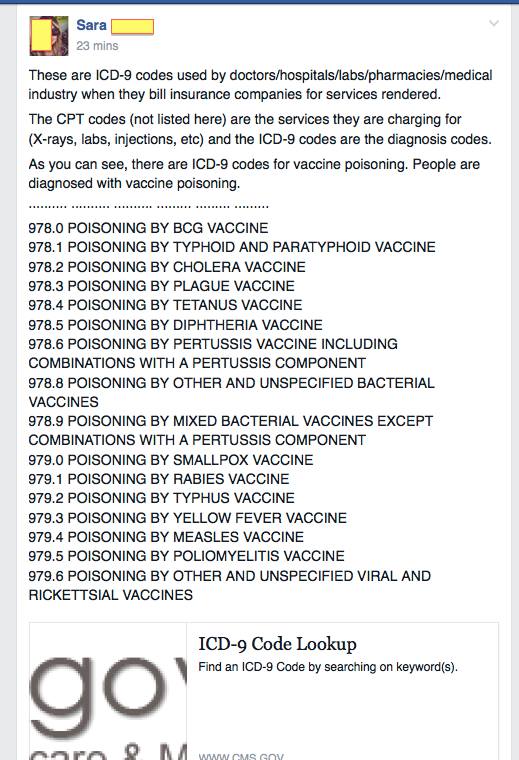
Recently, this list has been making the rounds in anti-vaccine circles, as proof that vaccine-related deaths are real. ICD-9 and ICD-10 codes are part of a standardized system used to facilitate communication between medical experts, researchers, and insurance companies. Anti-vaxxers believe that, because they include poisoning by vaccines, that must mean that vaccine poisoning is a real and common thing.
At first glance, it certainly looks suspicious. Why would insurance companies even have the option of billing for vaccine poisoning, unless it's something that actually happens with some degree of regularity?
In short, the answer is that there are ICD-9 codes for everything. And I mean everything. Not only can you also find poisoning entries for every conceivable medical substance that exists, but the ICD-9 list, which has over 68,000 entries, also includes some pretty bizarre and even inconceivable injuries. Here are a few of my favorites from both ICD-9 and its follow-up version, ICD-10.
974.1: Poisoning by purine derivative diuretics including theobromine
Literally, actually death by chocolate.
V91.07XA: Burn due to water skis on fire, initial encounter
Distinct from its counterpart entry for people who have had subsequent encounters with burning water skis.
T62.0X3: Toxic effects of ingested mushrooms, assault
Not just poisoning from mushrooms, but, y'know... those times when you're assaulted with mushrooms. Or by mushrooms. I'm not sure.
W59.22XD: Struck by a turtle, subsequent encounter
This person hasn't just been hit by a turtle-- not bitten, but struck by a turtle-- but it's happened more than once.
V97.33XD: Sucked into a jet engine, subsequent encounter
The only person in the world with worse luck than the victim of a serial attack-turtle... was apparently sucked into a jet engine and survived long enough to be sucked into another jet engine later on.
W55.29XA: Other contact with a cow, subsequent encounter
"Other" contact with a cow. My brain goes to some strange and disturbing places trying to imagine what gets this entry.
V00.01XD: Pedestrian on foot injured in collision with roller skater, subsequent encounter.
I hate it when I get hit by a roller skater more than once.
X52.XXXA: Prolonged stay in weightless environment.
Well, astronauts need medical care too, right?
V95.45: Spacecraft explosion injuring occupant
Because when a rocket ship explodes, the occupants are definitely going to survive long enough to be treated and billed for their injuries.
W22.0XD: Walked into a lamppost, subsequent encounter
Okay, guys, we all do things when we're drunk or texting, but I think this is something you get a pass for exactly one time. If you're having subsequent collisions with lamp posts, you need help.
Bottom line? Yes, there are insurance code entries for poisoning by vaccines. But that doesn't mean that vaccine poisoning is an epidemic, or even that it has necessarily ever happened. Unless you're also willing to use the ICD-9 and ICD-10 as evidence that our Reptilian Overlords are covering up an epidemic of turtle attacks, it's patently nonsense to use it as evidence of an epidemic of vaccine-related poisoning.
Labels:
anti-vaccine,
diagnosis codes,
evidence-based medicine,
funny,
humor,
ICD-10,
ICD-9,
meme,
vaccines
Don't Put Breast Milk in Your Vagina or Armpit
In my past life as a radical crunchy mom, I thought breast milk could do anything. When my daughter got a little case of pink eye and I squirted breast milk into it, it cleared up almost immediately and I declared the treatment successful. Never mind, of course, that most cases of conjunctivitis in babies are caused by viruses or clogged tear ducts, and clear up on their own.
I wasn't the only mom who was amazed by the magical healing powers of breast milk. Online, I saw thousands of moms all across the world recommending it to treat... well, everything. And I mean everything.
Let's take this one list, for example, by a mommy-blogger who clearly had her granola laced. She suggests breast milk for the following uses, among a few dozen others:
In the Ear
..."put a few drops of breast milk in the ear canal every few hours. This usually works to clear up the infection within 24-48 hours and is far safer, less expensive and a better solution than putting the child on antibiotics"
In the Nose
"For congestion in adults, try putting breastmilk in a neti pot to flush your nasal passages. If you don’t have a neti pot, just put a few drops of expressed milk in the nose like you would saline."
On Contact Lenses
"Did you get something on your contact, but you don’t have saline solution handy? Clean it with some expressed breastmilk!"
In Your Armpits
"One of my readers shares that she uses breastmilk as deodorant. Just rub some milk on your clean underarms and let dry."
In Your Vagina
"Sexual lubricant- Express breastmilk and use it as you would any lubricant."
Most people are aware that breast milk is milk and not panchrest, but since a few of us made the mistake of drinking the breastmilk-blended Kool-Aid, here's a breakdown of why breast milk doesn't belong in your ear, nose, eyes, armpits, or bajingo.
It's loaded with sugar. You know that whole thing about "human milk for human babies?" Well, there's a reason our milk is very different from, say, cows and goats. We make milk that has a high sugar content because lactose helps stimulate brain development and ensures that we feed our babies frequently. Breast milk is very sweet, which means that it tastes good to babies... and also to bacteria and yeast. After a couple of hours at body temperature, breast milk is going to invite all the yeast and germs in a hundred miles to a party in your crotch or sinuses. Gross.
It doesn't magically kill germs. It's true that the probiotics and antibodies in breast milk can help to fight infection in a baby's body. That's one of the reasons breastfeeding is so beneficial, especially in the first few days of life, when babies' immune systems are still immature. But that doesn't mean that expressed breast milk kills germs on contact and keeps them away. If it were truly inhospitable to bad bacteria, it would never spoil, but if you left your breast milk outside on a 99-degree day-- human body temperature-- it would no longer be something you'd want in your baby's body... or your own.
It's gonna stink. Breast milk has a nice smell, but please, for the love of all things holy, do not use it as a deodorant. Any mom who survived those first few days postpartum-- with milk leaking all over her shirt and a fussy baby who wouldn't let her shower-- can tell you that breast milk starts to smell after a while, just like any other kind of milk. You know: sour, acrid, and gag-inducing. If you do decide to put breast milk in your armpits, please do me a favor and stay a few feet away from me. I can do without the hugs, thanks!
It's not going to get to the infection anyway. Garlic oil, olive oil, coconut oil, vinegar, alcohol... There's a reason that putting things into your child's ear almost never works to treat an ear infection. Almost all ear infections in small children are in the middle ear or inner ear, not the ear canal. Ear drops can sometimes work to treat outer ear infections, but breast milk squirted into your child's ear canal isn't even going to touch his middle ear or inner ear. So, even if breast milk actually were the Philosopher's Stone, it wouldn't do anything for an ear infection.
The bottom line? Breast milk is a wonderful thing to feed your baby, but it's not a good idea to run around sticking it into random orifices in your body.
I wasn't the only mom who was amazed by the magical healing powers of breast milk. Online, I saw thousands of moms all across the world recommending it to treat... well, everything. And I mean everything.
Let's take this one list, for example, by a mommy-blogger who clearly had her granola laced. She suggests breast milk for the following uses, among a few dozen others:
In the Ear
..."put a few drops of breast milk in the ear canal every few hours. This usually works to clear up the infection within 24-48 hours and is far safer, less expensive and a better solution than putting the child on antibiotics"
In the Nose
"For congestion in adults, try putting breastmilk in a neti pot to flush your nasal passages. If you don’t have a neti pot, just put a few drops of expressed milk in the nose like you would saline."
On Contact Lenses
"Did you get something on your contact, but you don’t have saline solution handy? Clean it with some expressed breastmilk!"
In Your Armpits
"One of my readers shares that she uses breastmilk as deodorant. Just rub some milk on your clean underarms and let dry."
In Your Vagina
"Sexual lubricant- Express breastmilk and use it as you would any lubricant."
Most people are aware that breast milk is milk and not panchrest, but since a few of us made the mistake of drinking the breastmilk-blended Kool-Aid, here's a breakdown of why breast milk doesn't belong in your ear, nose, eyes, armpits, or bajingo.
![]() |
| Inflamed eye? Angry vagina? Infected ear canal? Regardless of what the Eye of Sauron looks like to you, it's definitely not a place where breast milk goes. |
It's loaded with sugar. You know that whole thing about "human milk for human babies?" Well, there's a reason our milk is very different from, say, cows and goats. We make milk that has a high sugar content because lactose helps stimulate brain development and ensures that we feed our babies frequently. Breast milk is very sweet, which means that it tastes good to babies... and also to bacteria and yeast. After a couple of hours at body temperature, breast milk is going to invite all the yeast and germs in a hundred miles to a party in your crotch or sinuses. Gross.
It doesn't magically kill germs. It's true that the probiotics and antibodies in breast milk can help to fight infection in a baby's body. That's one of the reasons breastfeeding is so beneficial, especially in the first few days of life, when babies' immune systems are still immature. But that doesn't mean that expressed breast milk kills germs on contact and keeps them away. If it were truly inhospitable to bad bacteria, it would never spoil, but if you left your breast milk outside on a 99-degree day-- human body temperature-- it would no longer be something you'd want in your baby's body... or your own.
It's gonna stink. Breast milk has a nice smell, but please, for the love of all things holy, do not use it as a deodorant. Any mom who survived those first few days postpartum-- with milk leaking all over her shirt and a fussy baby who wouldn't let her shower-- can tell you that breast milk starts to smell after a while, just like any other kind of milk. You know: sour, acrid, and gag-inducing. If you do decide to put breast milk in your armpits, please do me a favor and stay a few feet away from me. I can do without the hugs, thanks!
It's not going to get to the infection anyway. Garlic oil, olive oil, coconut oil, vinegar, alcohol... There's a reason that putting things into your child's ear almost never works to treat an ear infection. Almost all ear infections in small children are in the middle ear or inner ear, not the ear canal. Ear drops can sometimes work to treat outer ear infections, but breast milk squirted into your child's ear canal isn't even going to touch his middle ear or inner ear. So, even if breast milk actually were the Philosopher's Stone, it wouldn't do anything for an ear infection.
The bottom line? Breast milk is a wonderful thing to feed your baby, but it's not a good idea to run around sticking it into random orifices in your body.
Subscribe to:
Comments (Atom)

