Showing posts with label parenting. Show all posts

4 Reasons Not to Use Holding Therapy for Autism

There are many unscientific treatments for autism, but few are as dangerous or ill-informed as the use of "holding therapy." In theory, holding therapy for autistic kids works by forcing children to bond with their parents or caregivers, repairing supposed damage that was caused by their parents' inability or refusal to form a healthy attachment. Holding therapy involves restraining a child (sometimes violently) and forcing him to make eye contact or to give and receive affection. This method is not only ineffective; it can be deadly. Here are four reasons to never use holding therapy as a treatment for autism.
1. It's based on misconceptions and bad science. The use of holding therapy for autism arose in the 1950s, when mothers were almost always blamed for the challenges of their special-needs kids. Psychologists believed that autism happened because of "refrigerator mothers" who weren't affectionate or interactive with their kids. We now know that "refrigerator" parenting has nothing to do with autism. Most children with autism are parented affectionately and attentively, and the causes of autism are now believed to be entirely, or almost entirely, genetic. Given that the hypothesis behind holding therapy for autism has been proven incorrect, there's no reason to encourage or use the therapy at all.
2. Holding therapy ignores everything we know about autistic children. The idea that autistic children don't enjoy being held is a stereotype, and a harmful one, at that. Many autistic children are highly affectionate, often seeking out human contact excessively and inappropriately. There isn't a reason to force a child into something that she would seek out willingly. We also know that autistic children tend to become very upset by unwanted touches and unwanted eye-contact, and this could actually cause behavioral and developmental regressions.
3. It creates confusion about rules and body contact. Regardless of age, development, or emotional structure, all children need to know the rules for safe touches and contact with other people. A child needs to know that she is not allowed to touch people without their consent, that they cannot touch her without her consent, and that some types of touch (specifically, hitting and sexual contact) are never acceptable. When you restrain an autistic child against her will as part of holding therapy, you tell her that it's okay for one person to restrain another person and that adults don't have to respect a child's personal space. This can set up a dangerous precedent and could lead to the child being abused, or abusing someone else, due to confusion about touching rules.
4. Holding therapy kills children. Many special-needs children have died as a result of injuries incurred from holding therapy. This is probably the most serious and worrisome consequence of holding therapy for autistic children. Children have suffocated, starved, and been physically crushed by adult caregivers who were using holding therapy in a deeply misguided attempt to cure developmental or psychological problems in children. There is no reason to subject children to these dangerous practices because of a flawed and outdated understanding of the needs of autistic children. If you have, or know, a child with autism, contact his pediatrician for help with evidence-based therapies, rather than resorting to holding therapy and other dangerous practices.

7-Y.O.'s Parenting Book More Scientific Than Sears


Bill and Bob Sears-- father and son-- are the patron saints of today's crunchy parenting community. You can't swing a dead cat in a green mommy group without hitting a citation of Dr. Sears. It's convenient: when you want to say or believe something that contradicts medical consensus, it's nice to be able to have at least one doctor whose name you can whip out as evidence that someone has your back.

I've been there. I still vividly recall my embarrassment when I tried to cite Sears seven years ago and was quickly shut down by a pediatrician who told me he wasn't very smart and was out to make a profit by telling parents what they wanted to hear. I wouldn't have guessed that I would ever be on the other side of the fence. I definitely wouldn't have guessed that my daughter-- the unvaccinated, breastfed, all-organic baby on my hip-- would be.

Yet here she is. My seven-year-old wrote a parenting book more evidence-based and scientific than Sears. I didn't put her up to this. She did all of her research independently of me by reading parenting magazines, parenting books, and handouts she got at our health department and pediatrician's office. In fact, when I tried to get her to revise her page about sleep safety, she absolutely refused, telling me that it's her book and she's going to go with what the experts say. I cosleep with her baby brother, so reading about how he could "DIE" because of my decision was a little unnerving-- even though I know I weighed those risks against the risk I was taking by accidentally falling asleep with him in the rocking chair.

Here's what my daughter had to say.

Cover:

Being a Big Sister, Big Brother, Mommy, or Daddy

by: Vivian Russo


Table of Contents:

1. I'm going to teach you about...
2. How can we work together?
3. You should feed ___ to your baby
4. Where should my baby sleep?
5. When should I take my baby to the doctor?
6. What should I do if my baby has a diaper rash?
7. When should I feed my baby solids?
8. What should I be expecting?
9. How do I know when to feed my baby?
10. What can I do to help my baby's development?
11. How am I going to know when my baby will do what?
12. How do I show love to my baby?


Title Page:

Being a Big Brother, Big Sister, Mommy, or Daddy

by: Vivian Russo


I'm Going to Teach You About...

Hello, my name is Vivian! I am the author of this book that you're reading. I am 7 and I am going to teach you about being a parent or an older sibling! Also I am a big sister! My baby brother's name is Darwin! 


How Can We Work Together?


Working together is simple. All you have to do is think hard! My mommy, Juniper, has always thought of ways that I can help with Darwin! So has my Mer-Mer [other mommy], Meredith!


You Should Feed _____ to Your Baby

Babies under six months should have food that is mashed up and looks like apple-sauce but with a different color. Make sure that it is safe for your baby. To do this, use your memory. If your baby's pediatrician said your baby can have it, it is safe for your baby. So is it if there is a picture of something your baby can do on it. Some babies that are five months old can have apple-sauce.

Where Should My Baby Sleep?

The safest place for your baby to sleep is in a crib. It's not just that your baby has to be in a crib. The crib [should be] in the baby's parents' room. Here is why. If your baby does not sleep in your room, it will increase the risk of SIDS! Just like what would happen if you baby sleeps on his tummy! Now, why your baby shouldn't sleep in your bed: if your baby sleeps in your bed, you can roll over on him. In a crib, there is no one who can possibly roll over on the baby! Also there is nothing that can stop your baby from rolling off the bed. Newborn babies can DIE if they roll off the bed . In a baby's crib, if a baby rolls too far, they would just bonk their head a little. Also, never put blankets in a baby's crib, because they can get on their face, stop breathing, and DIE!

When Should I Take My Baby to the Doctor?

You should take your baby to the doctor when your baby has an appointment there, or is sick, or is hurt. Usually, when your baby has a doctor's appointment, it is because your baby needs a vaccination. Vaccinations prevent sicknesses and do not cause autism. In fact, my mommy didn't vaccinate me when I was a baby and yet I'm autistic! Also, if you hear that your baby is going to take a medicine that you don't want your baby to take, DON'T argue with the doctor! Ask questions instead.


What Should I Do If My Baby Has a Diaper Rash?

If your baby has a diaper rash, treat it with ointment. The best ointment is zinc-oxide ointment!


When Should I Feed My Baby Solids?

Once your baby's pediatrician says it is okay, your baby can have any food that it is able to bring to its mouth besides pecans, marshmallows, peanuts, and other things that are small or hard to chew.


What Should I be Expecting?

If you're pregnant with a baby, expect it to be like you: hungry a lot and hard to take care of.


How Should I Know When To Feed My Baby?

Newborn babies shake their heads and suck their thumbs when they are hungry. Other babies cry when they are hungry. Breast milk is best for babies. Formula is good, too. Don't give babies real milk!


What Can I Do To Help My Baby's Development?

Babies have good eyesight on things that are black-and-white. The book Look-Look is full of black and white things! Order it online to help with your baby's development.


How Do I Know When My Baby Will Do What?

Your baby's pediatrician will know, or you can contact Early Intervention to find out about it. All babies develop differently.

How Should I Show Love to My Baby?

Now that you have read my book, showing love to your baby is simple now that you know more about them!


Clearly, my seven-year-old has a firmer grasp on science than the leaders of the Cult of the Natural Mom. Here's what she got right that Bill and Bob Sears got wrong.

Introducing Solids: 

What my seven-year-old says: "If your baby's pediatrician said your baby can have it, it is safe for your baby. So is it if there is a picture of something your baby can do on it. Some babies that are five months old can have apple-sauce." [This refers to the labels on foods that say "supported sitter," "sitter," "crawler," or "toddler."] / "Once your baby's pediatrician says it is okay, your baby can have any food that it is able to bring to its mouth besides pecans, marshmallows, peanuts, and other things that are small or hard to chew."

What Dr. Sears says: "It's best to wait until at least six months to introduce solid food." / "By six to seven months of age, the intestines are mature and able to filter out more of the offending allergens. That's why it's particularly important to delay introducing solid foods if there is a family history of food allergy, especially to delay introducing foods to which other family members are allergic."

What the science says: Vivian is right. Sears is wrong. The AAP confirms it's okay to introduce solids foods, including highly allergenic foods, when the baby's pediatrician approves and when he has reached the necessary developmental milestones (which can happen for some babies at as early as four months of age). And the science shows that waiting too long for solids actually increases the risk of food allergies.

Safe Sleeping

What my seven-year-old says: "The safest place for your baby to sleep is in a crib. It's not just that your baby has to be in a crib. The crib [should be] in the baby's parents' room. Here is why. If your baby does not sleep in your room, it will increase the risk of SIDS! Just like what would happen if you baby sleeps on his tummy! Now, why your baby shouldn't sleep in your bed: if your baby sleeps in your bed, you can roll over on him. In a crib, there is no one who can possibly roll over on the baby! Also there is nothing that can stop your baby from rolling off the bed. Newborn babies can DIE if they roll off the bed . In a baby's crib, if a baby rolls too far, they would just bonk their head a little. Also, never put blankets in a baby's crib, because they can get on their face, stop breathing, and DIE!"

What Dr. Sears says: Sears claims that bed-sharing with a baby is actually safer than having a baby sleep in your room in a separate bed. He supports this claim by pointing out that all of his kids bed-shared and survived, and by collecting testimonials from parents who bed-share, whose babies aren't dead.

What the science says: Vivian is right. Sears is wrong. A massive study, the largest of its kind, examined rates of sleep-related death in babies across all different parenting styles and found that babies who bed-share have a higher rate not just of suffocation and overlaying, but also SIDS itself, compared to babies who sleep separately from their parents. This risk exists even when parents practice safer cosleeping. That's not exactly welcome news to me, since I bed-share with my son, but science is real whether I like it or not. That's why the American Academy of Pediatrics is clear on their sleep safety recommendations, which are identical to my daughter's. Room-share, but don't bed share, and put babies on their backs in a crib with no pillows or blankets.

Vaccines
What my seven-year-old says: "Vaccinations prevent sicknesses and do not cause autism. In fact, my mommy didn't vaccinate me when I was a baby and yet I'm autistic!"

What Dr. Sears says: "Some research shows that the measles virus in the MMR vaccine, which is given at age 1, may be one of the 'triggers' that begins the cascade of intestinal inflamation that leads to brain inflammation and autism. Honestly, I've read ALL the research, and both sides present good data and good arguments."

What the science says: Vivian is right. Sears is wrong. To date, there have been 118 studies-- 107 of them on this list-- proving that vaccines don't cause or 'trigger' autism. They are all much, much larger and more reliable than the single fraudulent study carried out by a rogue physician who is no longer permitted to practice medicine. Millions upon  millions upon millions of children have now been studied, and it is clear that vaccinated children do not have higher rates of autism. That's why it's the consensus of the American Academy of Pediatrics, the Centers for Disease Control, and every other major medical establishment in the industrialized world that vaccines do not cause autism.

Medication
What my seven-year-old says: "Also, if you hear that your baby is going to take a medicine that you don't want your baby to take, DON'T argue with the doctor! Ask questions instead."

What Dr. Sears says: "Try to avoid over-treating with unnecessary antibiotics [...] If the ear is not red or bulging and your child is acting fine, you may not need another course of antibiotics."

What the science says: Vivian is right. Sears is wrong. While increased antibiotic resistance is a serious consequence of the overuse of antibiotics-- something caused largely by the use of antibiotics in animal agriculture-- it is not a parent's place to decide when they are, or are not, necessary. The AAP advises doctors to be more judicious about when to prescribe antibiotics. It does not ask parents to make that call. If you're not a physician yourself, you are not in a position to "try to avoid over-treating." Ask questions if you're concerned. If your doctor thinks it's okay to forgo antibiotics, great. But don't make that call yourself.

Early Intervention
What my seven-year-old says: "Your baby's pediatrician will know, or you can contact Early Intervention to find out about it. All babies develop differently."

What Dr. Sears says: Sears's website has many articles about child development. Not a single one of them advises parents to talk to a pediatrician or Early Intervention about developmental delays.

What the science says: Vivian is right. Sears is wrong. Hands-down. The American Academy of Pediatrics, Zero to Three, and the CDC all strongly encourage regular developmental screening and early intervention for children who are not hitting developmental milestones on target. Science shows that there are essentially no drawbacks to early intervention: no side effects, no risks. Yet early intervention dramatically improves the wellbeing and learning of children with developmental differences. They speak, run, play, interact, and learn at a much, much faster pace and more completely than their similarly delayed peers who do not get EI.

Bonding
What my seven-year-old says: "Showing love to your baby is simple."

What Dr. Sears says: Well, there's an entire culture behind this one. Dr. Sears claims that his highly marketed form of parenting is the be-all, end-all of baby bonding. He warns against formula, cribs, strollers, and all those other tools for not-quite-so-perfect moms who don't necessarily want their children attached to them like limbs at all times.

What the science says: Vivian is right. Sears is wrong. there are as many ways to bond with babies as there are babies. Bonding is highly individual and varies based on the needs of the individual parent and the individual child. The American Academy of Pediatrics advises parents to bond through eye contact and loving touch, but emphasizes that babies with traumatic births and babies who can not be breastfed can still bond successfully.

This last part is what means the most to me, out of my daughter's entire masterpiece. When I had her, I honestly believed that, if I didn't do everything according to the rules prescribed by Sears, I would somehow not have the close bond with her that I desperately craved and wanted. As a result, I made myself sick and exhausted through years of unnecessary toil. I worsened my scoliosis-related back pain by wearing her for years. I gave myself premature osteoporosis by breastfeeding her for two-and-a-half years while battling an eating disorder. I went years without going out, or spending time with friends, or even remembering who I was outside of "Mama."

And it was all unnecessary. I don't regret bonding with my daughter, but when I had my son, I quickly learned that breastfeeding, baby-wearing, and immersive, all-consuming parenthood are not necessary-- or even always helpful-- for creating a strong bond between parent and child. In fact, my bond with my son was strengthened by the fact that I weaned him when it was medically necessary, that I sometimes leave him with babysitters when I need a break, and that I pee in peace without wearing him with me into the bathroom. I love him just as deeply and completely as his sister, because I bonded with him in the unique way that he and I both needed-- Sears be damned.

The Sears family isn't just sanctimonious. It's dangerous. They fuel the culture of women who forgo medically necessary medication so that they can breastfeed. Of moms who use the proven-dangerous alternative vaccine schedule recommended by Sears, unknowingly jeopardizing their children in the process. Of moms who make medical decisions that contradict the expertise of their pediatricians, because Sears told them that mom knows best.

My allegedly brain-damaged 7-year-old can tell the difference between Sears and science. Can you?

"Natural" Parenting is Unfeminist and Unnatural

I'm sure you've seen the tee-shirt. It's an old cliche that's been circulating since the first wave of feminists cleared the path we stand in today.

Across the chest, in clear, all-caps font, it reads, "This is what a feminist looks like."

"Feminist" can look like many things-- fat, thin, black, white, athletic, disabled, young, old, male, female. But I couldn't have imagined that the shirt would ever look so painfully ironic on me. I remember catching a glimpse of it in the mirror when my oldest child was two years old. I was emaciated, sick, dirty, and sallow. My eyes were mad with panic and sleep deprivation. I couldn't remember the last time I'd showered or slept. I was losing it.

This is what a feminist looks like,
indeed.

We rarely discuss the hidden costs of what the crunchy community calls "natural" parenting. We rarely talk about the toll it takes on women and the number of moms who have struggled, hurt, and even died because of a desire to fill the role of Perfect Mom. But natural parenting has a human cost. And women are almost always the ones who pay the price.

Let's consider, for example, Charlotte Bevan. She and her baby died because she stopped taking her medication for schizophrenia so she could breastfeed her baby.

Then there's Joanne Whale. She wanted a natural birth and trusted her body. She died as a result.

Or what about Katy Isden? She took her own life in devastation because her baby was unable to breastfeed.

Those are only the deaths of course. They don't account for all the other pains and toils of being a "natural" mom. They don't account for how it feels when it's two in the morning and you're absolutely covered in vomit and you really need to put your crying child down for a minute to take a shower, but you can't because your child shouldn't ever have to cry.


They don't account for how it feels when your doctor prescribes you a medicine that might impact your sleep, and when you ask your mom friends for advice getting your baby to sleep in his own crib, they all tell you to stop taking your medicine or to let your baby sleep with you anyway-- and you know that they're telling you to choose between risking your life or your child's.

They don't account for when you're in your twenty-third hour of posterior labor with a nine-pound baby and you're screaming in pain but know that you'd be betraying everything you believe in if you ask for an epidural.

They don't account for when you're extremely sick and you're so dehydrated that you pass out every time you try to stand, but your spouse keeps bringing you the baby so you can breastfeed him, and you don't even think of formula as an option.

They don't account for when you're "baby-wearing" your four-year-old and your back hurts so bad that you're near tears, but because she's a special-needs kid with gross motor delays, you can't let her walk... and you always swore you'd never buy a stroller.

They don't account for when your baby has never taken a bottle, and Dr. Sears and Dr. Newman both say that's fine-- even preferable-- and while you nurse your baby, you start weeping over how much you would give to just be able to leave him with someone else for an hour.

They don't account for when you banned food coloring and preservatives from your home and have to explain to your children why they can't have a Superman birthday cake or eat their Halloween candy.

They don't account for when you have to shake rotavirus diarrhea out of a cloth diaper while you're struggling with untreated morning sickness, and you retch and gag and dry-heave over and over.

They don't account for when your two-year-old is screaming in pain from an ear infection and you just keep putting garlic oil in it, hoping that it will somehow solve the problem, until you finally go to the doctor and hope that your crunchy friends never find out.

They don't account for when you really, truly, desperately miss your career, and you fantasize all day about just having a normal job and picking you kids up from daycare, but instead, you're at home spraying poop off your cloth diapers and wondering if anyone is ever going to know your deep, dark secret about wanting to go to work.

"Natural" parenting hurts. But more than it hurts men or even children, it hurts women. We are held to a superhuman standard of behavior. We are not supposed to have human needs. We are not supposed to need a night out with friends, or a job, or hobbies. We're not supposed to want to spend the day anywhere besides the playground, the farmer's market, the kitchen, or the homeschool co-op. We are not supposed to want sex, or alcohol, or soda, or babysitters. We are supposed to spend every moment of every day enslaved to our children, folding to their every whim, and we are supposed to enjoy it.


That's what the culture of crunchy motherhood-- the greener-than-thou cliques of organic Stepford Wives-- orders of us. That's why, in the "Bible" of attachment parenting authored by definitely-not-a-mother William Sears, all but one in twenty paragraphs is directed at mothers. It's why attachment parenting Facebook groups have a 98% female membership. It's why there are no beards anywhere to be seen at cloth diaper meetups. The culture of natural parenthood tells us that parenting is hard, and that those of us who give birth have an obligation to bear these burdens ourselves.


Real "natural" parenting: Aka Father with his son.

Perhaps the strangest reality of natural motherhood is that it isn't, in fact, natural. Women in hunter-gatherer societies actually have a tremendous amount of help caring for their children. Aka fathers, for example, hold their babies for about 20% of the day and most of the night, only passing them off to Mom or grandma to feed. Overall, hunter-gatherer fathers are actually more involved and more attached to their babies than people surviving by any other means of agriculture or production. If we want to live "naturally," we need to hold other caregivers responsible for our babies-- not just the parent who happens to have given birth.

Of course, it's never a good idea to do anything just because it's natural. But, if your goal is to live in the way that humans were designed to live, the kind of attachment parenting that places near-sole responsibility of children on their mothers' shoulders isn't the way to go. Real natural mothers have help. They have sisters, brothers, husbands, grandmothers, grandfathers, aunts, uncles, cousins, and friends who feed, nurse, and otherwise care for their babies. They don't spend the first three years of their babies' lives as most crunchy moms do-- drowning in sleep deprivation and worry. They have help.

We need to abandon the toxic, sexist culture that has come to dominate the natural parenting community. The culture of crunchy moms that values a child's every whim over the human needs of his mother is not a sustainable culture at all. It's time to shed our conceptions of motherhood as an arms-race to see who is the most successful martyr of natural parenting. It's time to stop shaming mothers who can't, or don't, breastfeed, cloth-diaper, stay at home, homeschool, buy organic, and cosleep.

It's time to evolve.


A Mother's Worth Isn't Measured By Pain


I was in hard labor with my son and my blood pressure was through the roof, thanks to a severe case of late-onset pre-eclampsia. Even after I was given several medicines to bring my blood pressure down, it was still getting dangerously high during contractions, with systolic reading climbing above two hundred. Still, I had my heart set on "natural" labor. When the nurse said that I may need an epidural-- both to control the pain, which was worsening my blood pressure, and to prepare for the possibility of an emergency C-section-- I shook my head in horror.

"But what if the baby thinks I don't love him as much as I love his sister?" I squealed, white-knuckled and in tears through another contraction.

It didn't make sense, but pain and panic will do that. In that moment, I honestly thought that, if I got an epidural with one child and had a natural labor with the other, it would somehow mean that I loved one child less than the other. Fearing a C-section, I ended up consenting to an epidural-- though, as fate would have it, my scoliosis prevented it from working. My son was born a few minutes later, perfect and beautiful. The needle in my back didn't make any difference in the immediate feelings of love that I felt for my son.

Of course, now that the pain and anxiety are behind me, I realize how silly it was that I ever thought that the amount of pain I experienced during labor was somehow a reflection of how much I loved my children. But I can also understand why that thought was there. I had gotten caught up in the culture of birth-shaming that tells women that their willingness to endure unnecessary pain (or not) makes them better or worse mothers. And, though I wouldn't have held anyone else to the same standard, I told myself that I could only be a good mom if I went through unmedicated labor with both of my nine-pound posterior babies.

The feeling followed me through my first few months with my son. I endured an extraordinarily painful surgery to correct trauma from childbirth, and took as low of a dose of pain medication as possible to avoid passing medication to him through breast milk... Even though that meant spending hours of every day for two weeks curled into a ball, sobbing my eyes out and sometimes even involuntarily screaming. Surgical recovery hurt as much as transition-stage labor (something I've experienced twice without medication), yet I endured it because I thought that I would be a bad mother if I exposed my son to pain medication-- or, Sanctimommy forbid, formula.

It didn't end there, and here's where my dangerous commitment to unnecessary pain nearly cost me my life. As I wrote in another article, my doctor repeatedly urged me to wean my son so that I could take the high-dose central nervous system depressants that she said were necessary for controlling my extreme case of postpartum anxiety. But I believed that doing so would make me less of a mother. I felt like breastfeeding was the one thing that I still "had" of my identity as a crunchy martyr of a mom. Even when I became so sick that my lips were blue and I was fainting a dozen times a day, I refused to wean my son because I didn't want to be selfish. As a result, my two children nearly lost me.

Two days ago, my daughter brought up natural childbirth for the first time in her seven years. She asked me why it hurts to have babies. I explained to her that the pain is because a mommy's uterus needs to squeeze very hard to push the baby out, and because the mommy's vagina has to go very quickly from being the size of a nickel to being the size of a watermelon. Here was the convesation that I had once, in my juvenile naivete, somehow expected to be my opportunity to prove my worth as a mother to my kids.

"Can't they give you medicine so it doesn't hurt as bad?" she asked.

"They can," I explained, "But I chose not to. I wanted to be able to experience everything and I didn't want you to be exposed to any medicine that might hurt you."

Somehow, all these years later, it seemed like a pretty pathetic reason to go through that kind of pain when there's an alternativce. She paused for a long time. Where was the applause, the gratitude, that I had somehow expected? And why had I expected it?

"I think I would have taken medicine, if I were you," she said plainly, with a shrug.

Seven years ago, I had expected this conversation to be one about what an amazing mother I was. Seven years ago, I had expected to be able to say, "It was twenty-three hours of labor, and you were backwards, and it hurt so bad that I cried, but I loved you so much that I went through it." Seven years ago, I had thought that this made me an amazing mother. But this was a completely different conversation, and hindsight is 20/20.

"When you have children of your own, that's a completely okay choice for you to make," I said, "Now that I think about it, it's kind of funny that I thought I had to go through a lot of pain just to make myself a good mom."

"I think you'd be a good mom even if you'd taken medicine," she agreed.

And she was right. My value as a mother isn't in how much pain I went through, or how many hours of labor I endured, or how long I breastfed them. My value as a mother is in how many hugs I give, how many stories we read, and how hard I'm willing to fight to keep my kids happy, healthy, and comfortable. I didn't have to go through as much pain as I did. I could have accepted the interventions that could have made labor less stressful and traumatic to me. If I had wanted to, I could have even had a C-section, and it wouldn't have made me less of a mother.

Ultimately, I don't regret my unmedicated births-- my daughter's, which was planned, and my son's, which happened because of a failed but medically indicated epidural. I don't regret them, because my daughter's made me feel empowered and accomplished. It gave me the ability to say that, as young and vulnerable and unprepared for parenthood as I was, I was able to do something that many women can't do. And I don't regret my son's because it taught me that addressing pain can be a medical necessity and that I wasn't selfish for accepting it-- even though, in my unfortunate case, it didn't work anyway. But I am glad that I learned what just might be my most important lesson as a mother: that we can't judge our worth as parents based on how much pain we endure.

No, Anti-Vaxxers, I Don't Have Munchausen By Proxy-- But You Might.

Anti-vaccine activists have hurled a number of false, and often strange, accusations at me since I first began publicly advocating for vaccines. Mostly, I hear that I'm not a real person; I'm a sockpuppet for the pharmaceutical industry. I also hear pretty often that I'm a shill. Most recently, a number of anti-vaccine activists informed each other that my daughter does not really have autism. They say that I conditioned her to act autistic, either because I crave victimhood or because I get paid by the pharmaceutical industry for it. They have publicly stated that I suffer from Munchausen syndrome by proxy.

MBP is a very serious form of child abuse. It involves a caregiver (usually, but not always, the child's mother) claiming that a child has symptoms of serious illness, and either behaviorally forcing the child to act sick, or actually poisoning, starving, or injuring the child to cause sickness. The victims of MBP are in and out of hospitals with mysterious symptoms. They miss school. They're underweight. Many of them die from their mothers poisoning or starving them. If I had MBP, it would mean that my kids were in very serious danger, and for their sake, I would hope that someone would intervene if that allegation were true.

So let me at least clear this one thing up: no. My children are healthy and very well cared for. My youngest's biggest health problem is that he's cutting his teeth too early and it bugs him. My oldest child's biggest health problem is that she makes poops the size of submarines that I can't flush. They see their doctor routinely, are up-to-date on their immunizations, have never had an unexplained illness, and have never been hospitalized except at birth. My oldest was diagnosed with autism by a team of well-qualified experts who conducted over a dozen tests and closely observed her at home and on the classroom. There is absolutely no merit to that accusation.

The thing that I would find funny if it weren't so tragic is that this accusation came from the anti-vaccine movement, of all places. Not all anti-vaccine or vaccine-hesitant parents have MBP-- I was once anti-vaccine, and I did not have MBP then and don't have it now-- but almost all people with MBP are anti-vaccine. The anti-vaccine movement provides a safe haven for parents with MBP, both because these parents can often get fraudulent diagnoses from unlicensed health care providers, and because the conspiracy-theorist culture of the anti-vax movement encourages them. It's easy to hide medical abuse when you're among conspiracy theorists who claim that the government hides vaccine injuries and kidnaps babies for no reason.

Many might recall Lacey Spears, the notorious "mommy blogger" whose son spent his entire short life under the care of naturopaths, bouncing from one vague diagnosis to the other, before finally succumbing to poisoning by his mother. And just recently, we wrote about Caroline, a little girl whose parents have been subjecting her to nothing short of medical torture in an attempt to cure her alleged vaccine injury. Caroline's family shows classic symptoms of MBP, right down to their attention-seeking Facebook pages and blogs where they discuss her "struggle."

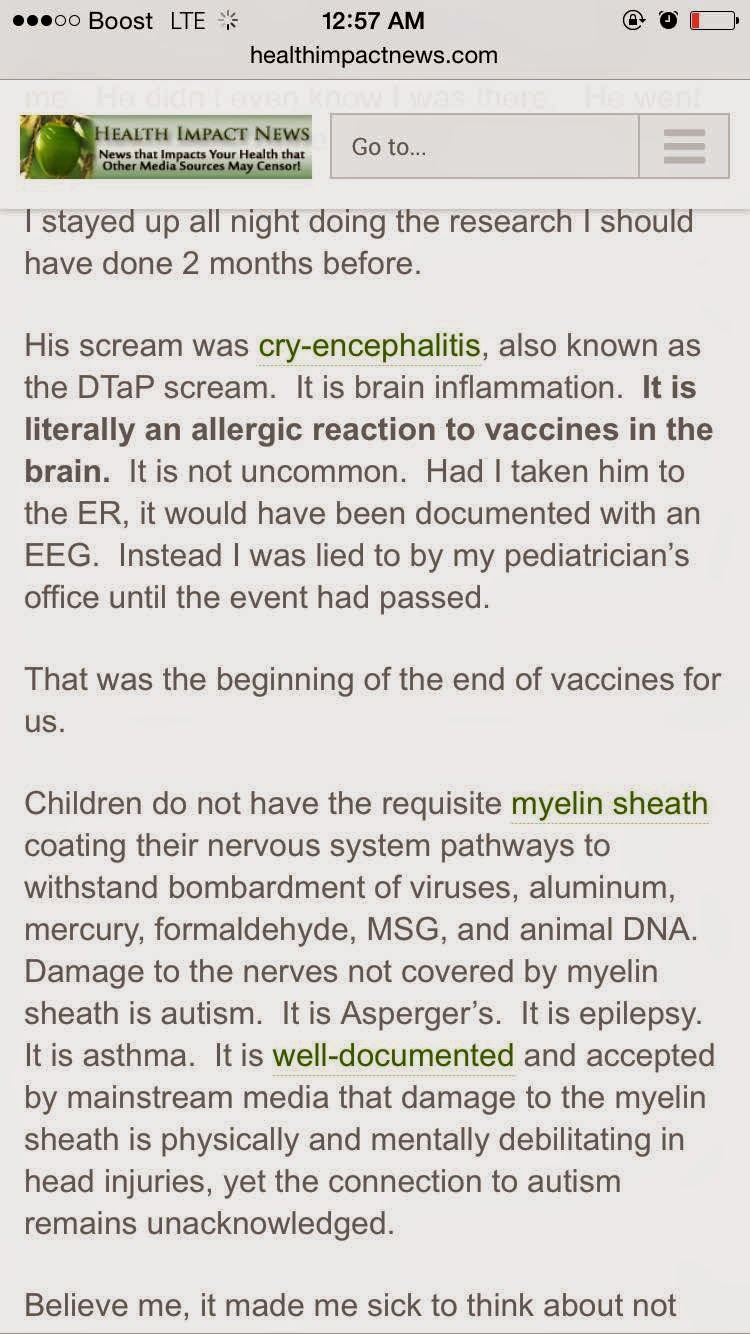
The anti-vaccine movement is so filled  with Munchausen by proxy that it's alarming. In fact, anti-vaccine websites, forums, and Facebook pages have support forums specifically set aside for parents who say they are being "falsely" accused MBP. Anti-vaccine support groups are full of people giving accounts of what can only be described as MBP symptoms. They diagnose with own children with food allergies, autism, brain damage, encephalitis, heavy metal poisoning, chemical sensitivities, autoimmune disease, systemic yeast infections, and intestinal parasites. They imagine that their children's bodies are delicate snowflakes that can't withstand the vaccines safely tolerated by all but one in a million kids. When their doctors tell them that that their children do not have these conditions, they go elsewhere. They accuse their doctors of fraud and seek naturopaths who back up their misdiagnosis.

Again and again and again, anti-vaccine activists claim that their doctors are involved in fraud or cover-up. When they diagnose their children with lead and mercury poisoning, and the doctors say that the bloodwork doesn't show it, they seek the aid of labs that willfully falsify test results-- enablers of Munchausen by proxy. When they diagnose their own children with encephalitis and their doctors say that crying after a vaccine is normal and not a sign of brain inflammation, they spread conspiracy theories about cover-ups-- neverminding, of course, that children with untreated encephalitis invariably die. When they diagnose their own children with vague food allergies and insensitivities, restricting their diets to the point of causing severe malnutrition, they insist that doctors just "don't know" and that their claims as parents matter more than the results of diagnostic tests.

I would be writing this post for weeks straight if I found all the accounts that sound like Munchausen by proxy by anti-vaccine activists, but here are just a few screencaps of just a few of them.


The thing that's crystal-clear is that the most prominent members of the anti-vaccine movement show all the most worrisome signs of Munchausen by proxy. Their children tend to suffer from vague symptoms that can not be explained through medicine or science. They diagnose their own children with conditions that doctors say they don't have. They put their children through experimental treatments that are condemned by mainstream medical experts. They hop from one "expert" to another when caregivers begin to notice signs that the parents may be responsible for the illness. The scariest thing is that many of them are successful not only in abusing their own children, but also in convincing others to do the same. Anti-vaccine forums have largely become support groups for people with Munchausen by proxy who are helping each other maintain abuse without prosecution or accountability. It's dangerous and it's deadly.

I have two very happy, healthy children. I am grateful for that every single day. My oldest has autism, but I not only don't consider that to be a disease, but her form of autism would be impossible to "condition" or create. There is no way to condition a six-month-old to have gross motor delays or to condition a two-year-old to have echolalia, or to condition a five-year-old to write entire pages of text in perfect mirror-image. These traits are not the result of my conditioning, but of a unique and beautiful neurology that I joyfully accept and embrace. If you could possibly accuse me of having Munchausen by proxy, it might be time to check and make sure that you're not in fact looking into a mirror.

5 Reasons I Don't Use the GFCF Diet

Within autism parenting groups, I feel like I'm a member of a tiny minority. All the other special-needs parents I know are constantly exchanging diet tips for the increasingly popular GFCF (gluten-free, casein-free) diet, which is widely touted for its purported ability to reduce autism symptoms-- or, some say, "cure" the condition altogether. But despite its popularity, I won't be switching my child to the GFCF diet at any point in the foreseeable future. Here's why:
1. There's no proof that it works. The Cochrane Collaboration, an unbiased nonprofit that investigates the evidence behind health-related treatments, looked at all the available evidence for the GFCF diet for autism. They found that it's one of many very commonly used treatments for autism, but that, so far, there's not much reason to think that it works. Drawing from the pool of all available research, the organization concluded, "Current evidence for efficacy of these diets is poor. Large scale, good quality randomised controlled trials are needed."

Similarly, Elsevier published a review and concluded that GFCF diets shouldn't be used for autism: "Critical analysis of each study's methodological rigor and results reveal that the current corpus of research does not support the use of GFCF diets in the treatment of ASD."
2. I don't want to encourage an eating disorder. Autistic children are notoriously picky eaters and, in some cases, picky eating can turn into a serious eating disorder. Believe me, I've been there and done that, as a survivor of orthorexia. There's evidence that people with eating disorders have very high rates of autism-like symptoms, and even that autism and anorexia might be the exact same condition. Why take a child who is already at a high risk of developing an eating disorder and enforce an even more strict diet on them? My daughter already has her share of unhealthy behaviors when it comes to food, and I don't want to encourage food aversions or compulsions by unnecessarily restricting her list of "safe" foods.
3. There are serious health consequences of the GFCF diet for autism. GFCF diets for autism aren't risk-free; they can cause serious nutritional deficiencies. The systematic review in Elsevier found that autistic children on GFCF diets may be at a higher risk for bone problems. A GFCF diet can also lead to many deficiencies in vitamins and minerals and can lead to either severe weight gain or weight loss, both of which can be serious in children. And many people adhering to the GFCF diet develop diarrhea or constipation, which can be especially problematic for autistic kids, who are already prone to these discomforts. My daughter's picky eating has already led to some run-ins with anemia in the past, and I'm not going to chance putting her at a high risk for future deficiencies. Why chance it, especially when there's no proof it works?
4. Several healthy alternatives to the GFCF diet exist. There isn't much evidence to support the GFCF diet, but there are many other dietary changes that might benefit kids with autism. The Feingold Diet in particular, which eliminates food coloring, artificial flavor, and petroleum-based additives, is very low-risk and much healthier than the GFCF diet. Although it was created for children with ADHD, it could theoretically help autistic children, as well, and doesn't carry the same kinds of nutritional risks as GFCF diets. Does it work? Probably not. And it's certainly not going to cure autism. But if you want to give a dietary change a try, it's best to start with one that won't hurt. It's possible to switch your kids to a healthier diet without leaving the nutritional gaps associated with gluten-free and casein-free lifestyles.
5. I don't want a cure. When I hear other parents talking about "curing" their kids' autism, or the miraculous treatments that supposedly make it vanish overnight, I cringe. I don't want to change who my daughter is or separate her from her neurology. I do not want a cure for autism because I don't think it is a flaw or a defect. So, even if I knew that a GFCF diet for autism would "cure" my daughter overnight, I wouldn't pursue it unless it was a choice she made independently of me. And, considering that it doesn't seem particularly safe or effective anyway, I don't think I'm missing out on much. I'm not going to restrict my child's food intake in some desperate attempt to alter her identity.
I'm happy for now having my family follow a balanced, minimally processed diet, and to help my daughter through any struggles she has using more effective means. If you're considering using a GFCF diet for autism, get in touch with your child's pediatrician so she can help you evaluate the benefits and risks. You can make the best possible decision for your family only when you have enough information to do so.

Extremist Natural Parenting Creates Horrible, Unhappy Children


(Stock image- this is NOT one of the children discussed in this post.)


When I was eighteen, I met a family that at first seemed to be exactly who I wanted to be one day. They were radical, natural-living parents with three kids who spent their days picking berries and playing outside. At the time, they were eight, seven, and four years old, and they seemed like the happiest family I could imagine. For the sake of protecting their privacy, we’ll call the kids A, B, and C.

I was thrilled. I told the parents all about my aspirations to be a mother one day and to do all the things they were doing: natural birthing, alternative medicine, cloth diapering, homeschooling, gentle discipline. I even told the mother that she was exactly the kind of mom I hoped to be one day. And at the time, I meant it.

Much to my excitement, they hired me as their babysitter… and I found out what radical “natural” parenting is really like, in all its horrors. To be clear: there is nothing wrong with gentle discipline. There is nothing wrong with homeschooling. There is nothing wrong with green living. These are all choices that I whole-heartedly support. But what this family did was so extreme that it rocked my world, and, luckily, taught me a thing or two about how not to parent.

The first time I babysat for them, I was eager to read books to them. But, for a homeschooling family, they had very few—maybe fifteen altogether. Worse: the kids not only couldn’t read the books, but the older two, at seven and eight years old, barely knew how to identify any letters at all.

“Do your parents not read to you?”

“Sometimes,” B explained with the severe speech impediment she shared with her two siblings, “But they think it’s better for us to see the real world.”

“I don’t like the real world,” A said sharply, “I like video games.”

“Oh?” I was a little surprised. Too natural for books but they played video games, “Your parents don't have rules about video games?"

“We don’t really ave rules.”

“You don’t have rules at all?”

“Mommy makes requests but we can choose whether or not to do what she asks.”

I tilted my head a little to the side. That seemed strange to me, but then again, these people were over a decade older than me and seemed to know what they were doing. They were confident in their parenting skills, and if it was working, it was working, right?

The next time I babysat for them, A played violent video games the whole time. Because he couldn’t read, he kept demanding that I read the dialogue to him. When I reminded him to say please and thank you, he refused and threw the controller at me. I told him he wasn’t allowed to play any more video games until his mother came back—a decision that triggered a wild, flailing, screaming tantrum on his part. He told me that he hated me and called me a “mother*cking b*tch”—this from an eight-year-old, mind you-- and told me to go “f*ck” myself. His little brother and sister cowered in a corner, looking like they had seen this many times before.

When his parents came home, I was shaking and explained to them what happened. They shrugged as if I had told them he’d eaten too many cookies and said that “He’s like that sometimes.”

Then they blew my mind by telling me not to ever use punishments like that again.

“In our family, we operate by consensus and compassion,” the mom sanctimoniously explained, “We don’t tell people to do anything; we ask them nicely. If they don’t do it, they have that choice.”

“So what about when he doesn’t obey me?” I asked, incredulous.

“He doesn’t have to.”

“So when I ask him to say please and he refuses…?”

"He doesn't have to."

"And if he curses at me again?"

“It’s his choice in how he communicates.”

She pointed to a print-out on the wall from a gentle-parenting website and told me to read it to her kids whenever I was asking them to do something. I can’t remember it verbatim, but it said something like, “I want you to do this only if you can do it with the joy of a child feeding ducks. I don’t want you to do this because you fear me or because you think I you will disappoint me."

The next time I babysat for the family, I found myself reading and reciting the line over and over, to no avail. The pattern continued: A had tantrums, B was afraid, and C obliviously played with little toddler-toys and didn’t seem to notice the state of turmoil in the family.

One day, C was crying inconsolably the entire time I was there. He kept pointing to his genitals and crying, “Ouch!” I asked him if I could look and saw one of the most horrifying injuries I’ve ever seen—his scrotum bright-red and swollen to nearly the size of a softball, clearly infected. A and B informed me that four-year-old C had gotten a tick bite on his scrotum that had become infected, and their parents were treating it with homemade plantain-leaf salve.

When they came home, I brought my concerns to their attention, and, much to my relief, they took him to an actual pediatrician the next day and got him a prescription for antibiotics. I’d like to think that they would have done it even if no one had found out about their son’s infection, but I have a sinking feeling that they would have let the infection fester until it made him sterile or dead.

Eight-year-old A’s violent tantrums grew worse and worse, and eventually, at wit’s end, I finally said, “Look, your parents don’t believe in punishment, but I do. You are going to stop acting like this. You are going to sit down, behave yourself, and practice writing your name. Do you understand me?”

He screamed, “F*ck you!” to me and ran outside.

The next time I came over, I saw him sitting smugly on the couch with his arms crossed.

“I can’t let you past the door,” his mother said apologetically, “Because you’re not allowed here anymore.”

“Not allowed? What did I do?”

“Our family operates by consensus, and you don’t have A’s permission to be here anymore. B and C still like you a lot and want you to babysit, but A won’t allow you in the home so you’ll need to do it somewhere else if you’re still interested.”

I tried. I really tried. Because somehow, I had really started to love those kids. After a few months, I eventually taught B how to read short sentences—she was very smart and caught on quickly-- and I was playing fun make-believe games with C. I grew close with their father and tried to understand his parenting choices. I suspended disbelief and tried to convince myself that the parents knew what was right for their own kids. I had to make sense of it. It couldn't be as bad as it seemed, could it?

Then it got even more disturbing. I saw that their mother, completely covered in bruises. She looked like a stereotypical victim of domestic violence, but I knew her husband wasn't the one who did it.

"Are you okay?" I asked her quietly, feeling truly sorry for her. How awful, to be assaulted by your own child.

"I'm trying not to make a big deal about it," she said.

I had been biting my tongue for a long time, wanting to believe that this family knew more than me about parenting because they were older and more experienced, but I couldn’t hold my words in any longer.

“Your kids need help,” I told her, shaking.

“I already have a therapy appointment for A,” she conceded. I wondered what else she wanted to say. I wondered if her experiment in permissive parenting had ended and if she had finally concluded that she had messed up, terribly, and that her kids were hurt because of it.

About five years ago, I spoke to someone who knew the family and I was disturbed, but not surprised, by what I found out. B had desperately wanted to go to school and was enrolled in public school that year—that was the good news—and her little brother C ended up coming along. After hearing how much fun they were having, A asked to attend school, too, where he was quickly expelled for his frequent violent behavior. B and C were doing okay, but A had become so dangerous and volatile—a threat to his parents, his peers, and his siblings—that his parents were struggling to decide what to do with him.

I wish I had never met those children, not because they were “bad,” but because it absolutely broke my heart that their parents had made such reckless decisions in the name of “nature.” Their children were hurt by their negligence and dedication to a laissez-faire parenting attitude that eschews discipline and education in favor of allowing children to make their own rules.

A, B, and C are all teenagers and young adults. I think about them often, because they gave me an opportunity that I couldn’t have gotten from anywhere else. I learned how to care for kids because of them—and I learned how not to. They were difficult children, but they were still children, and they were children who I had ultimately loved deeply and completely.

Children deserve to be loved, and part of love is disciplining, not just “gently” and passively, but sometimes firmly and authoritatively. Children need guidance. Children need to sometimes be told, “No.” Children sometimes need to be punished. And children sometimes need to know that the world isn’t always going to care about their feelings or dignity, and that sometimes they have to do as they’re told because it’s what’s necessary.

Thank you, A, B, and C, for what you did. Thank you for letting me know you and love you. And above all else, thank you for showing me exactly how I don’t want to raise my own children.

Developmental Delays Made Me a Mother


My son had a developmental evaluation a few days ago. It was his second in his eight months of life.


My son ultimately passed his screening, though he’s lagging a bit behind average in his gross motor development. This didn’t faze me at all; we’re a family of late walkers and early talkers. We’re clumsy and intellectual. Maybe he’ll surprise us and grow up to be a star athlete rather than a book worm, but for now, he’s following a path toward becoming himself, and, like his hair color and eye color, it's likely to imitate his closest relatives. 

The strange thing is that I hadn’t always been this accepting. Almost seven years ago, I had encountered the professionals at Early Intervention for the first time, and it was shocking and scary for me. I had cried. I had screamed. I had punched my pillow. I had called friends and relatives in absolute choking tears. Why?

All because of one tiny little glitch in my daughter’s development: she wasn’t supporting weight on her legs. It was a melodramatic, hysterical reaction to have to something so incredibly insignificant, but, at the time, it seemed like one of the biggest crises I had ever encountered.

 After my son’s evaluation, I started thinking about how much I have changed in the last seven years. I did an archaeological dig through the ancient ruins once known as Myspace. In one of my last posts before I abandoned the glittery .gifs and horrible background music, I had begged for help from my friends on a blog post:


:( 
I took Vivian to the doctor yesterday and everything seemed just fine. The doctor was gushing about how chubby and cute and bright she was, and was saying that she seemed to be ahead of the curve on every milestone. "She's doing great, you're doing an excellent job with her!" the doctor had said.
 
And then came the reflex test. :( Vivian is way behind the typical curve with controlling her feet; she's supposed to spread her legs out and try to balance on her feet as I put her down, and she doesn't. I had no idea that she was supposed to be doing that. :( Most babies her age can stand for a  few seconds with support.
 
The doctor looked at her legs, spine, and feet, and said there didn't seem to be any physical problem, and said that because Vivian's so talkative and aware, it's highly unlikely that there's a mental problem. But, for some reason or another, she's behind on her motor development... Far enough behind that she's going to need classes with a group that helps children with developmental delays. I can't even describe the way it felt when they handed me the pamphlet for Hand in Hand, which deals mostly with children who have autism and cerebral palsy.
It's not that I think she's "better" than children with delays, I just never imagined that she would have any.
 I feel horrible and panicked and guilty. I don't know why I've got it in my head that I did something wrong, but I feel like I'm a terrible mother. 
Most likely, she just doesn't know how to use her legs much because she never has to (I'm holding her all the time) but it still scares me that it's a significant enough delay to warrant treatment. The doctor reassured me that it's very unlikely that there's anything truly wrong with her, and said that, most likely, she's just going to be a late walker. She's either ahead of the curve or right on it with all her other keystone developments.
 I still feel really awful, though. :(
Please hug me. 


“I feel like I'm a terrible mother.”Oh, how those feelings had wounded me, back then. I had done everything right. All-organic diet, exclusive breastfeeding, natural birth, delayed cord clamping, no medications, no mercury, no vaccines. I did everything right, and as much as I had tried to tell myself that I wasn’t so arrogant as to think that developmental delays only happened to bad parents, the feeling was there.I did everything right. This was supposed to happen to someone else.When I see the things I wrote and felt during what seemed like a total crisis—something that really wasn’t a big deal at all—I feel a conflicted jumble of anger and pity for the mother I was seven years ago. I want to hug her. She was asking  for hugs, after all, with the tone of a scared child who had accidentally waded into the deep-end before knowing how to swim out. She was a mom who knew how to be a good parent only if everything went exactly as she planned. And when it didn’t? She thought it was all over.Here’s what I wish I could go back and say to that scared woman, myself at twenty-one: You’ve only been a mom for six months. You have so, so, so much life ahead of you and your children (yes, children, plural—there’s a black-eyed baby boy waiting for you in your future!). You are so naïve that, right now, you honestly think that the best moments of parenthood are already behind you, just because of a failed developmental screening.

They’re not. They’re still ahead of you. They’re still ahead of me, too.
Your daughter’s developmental delay is the very, very beginning of you becoming a mother. You’ve loved her for the last six months, but you weren’t her mother yet. Not really. Because being a mother isn’t about knowing what to do based on those endless hours you spend poring over the internet, plagued by your neurosis. Being a mother is about love, and it’s about acceptance. And until you can really look at yourself and say, “My child is different, and I love her exactly the way she is,” you’re not a mom. You’re just practicing.If your daughter hadn’t been born different, it might have been years before you really, truly became a mother. You would have accepted her, but the acceptance would have been superficial and empty-- acceptance of an idea of who she should be, not an acceptance of who she actually is. How can anyone say that they really love someone, if they want to change who that person is? How can you really say that you’re a mother, if the child you really love is an expectation—not a reality?
There are so many wonderful things in your future, and your daughter’s developmental differences aren’t obstacles to that.
They are catalysts for it. That early babbling? She’ll say her first word in just a month and sentences won’t be far behind. Later, she’s going to spend hours upon hours talking to you about cats and dinosaurs and magic and love. That clumsiness? It’s perfect. You’re not going to have to struggle to keep up with her, or worry about her climbing your countertops. All those things that just make her seem… odd? Oh, Juniper. That’s the best of the best of it. She will be wonderful. You will love her, and you will love her differences, and you will not want to change a single thing about her.One day, you will bring a little baby boy into the world, and it will be entirely different because you will have already learned this critically important lesson. You will already know how to be a mom, and when you meet him, his soft little body in your arms and his fuzzy black hair against your fingertips, you won’t fall in love with an expectation of who he is. You will fall in love with anything and everything that he may become. You will know the most important lesson a mother can possibly know: that your job of creating your child is over when they are born, and that your task from then forward is to discover them. You will be a better mother because of the lessons your older child taught you.We have a long, long way to go. Neither of our children are anywhere near the difficult ages of adolescence, and both of them are happy and healthy, and the biggest challenges we have in parenthood are almost certainly waiting for us down the road. These are days that we will remember as the happiest: when she was a bouncing ball of energy nearing seven years old, and when he was a thoughtful little cuddle-bear who loved touch-and-feel books and lullabies. Things will be hard, one day, but that day isn’t yet, for me or for you. Right now, from your world in 2008 and my world in 2015, we are both looking at the good times. Enjoy them while they last, and I’ll do my best to do the same.This isn’t the end. It’s the beginning of something wonderful and magical.


I Gave My Child Autism


I gave my child autism.


It wasn’t because of vaccines. It wasn’t because of tuna. It wasn’t because of formula. It wasn’t because of Tylenol, ultrasounds, antidepressants, Pitocin, tobacco, television, or pesticides.

How do I know? Because she wasn’t exposed to any of these things when she was first diagnosed with developmental delays.

Yet, I know it, from the bottom of my heart: I gave my child autism.

My first clue that I gave my child autism came when she was in the middle of an evaluation by a speech-language pathologist at two and a half years of age. The therapist had noted that her eye contact was poor, but acceptable for her age.

“Oh,” I explained, looking straight at my lap, “Well, that’s probably a learned behavior. We just don’t really ‘do’ eye contact in our little family. I’ve never been much of an eye contact type.”

The speech therapist bit her lip.

The same pattern was played out time and time again as we danced between physical therapists, occupational therapists, speech therapists, neurologists, psychologists, and teachers.

“No, she’s not potty-trained, but I still had accidents all the way into second grade. It just runs in the family.”

“Hyperlexia? Yeah, she’s a great reader. My family is full of early readers.”

“Picky eating is just something she got from me. I don’t like food much. And as a kid, I would completely flip out if someone tried to make me eat with a spoon or eat foods that had touched each other on my plate. No big deal."

“Clumsiness runs in the family. I couldn’t ride my bike until I was eight, so the motor delays are just in her DNA, that's all.”

“Oh, sure, she won’t wear her pants correctly, but that’s just another thing she got from me. You should have seen how I use to shriek if someone put a turtleneck on me!”

“Sure, she can’t dress herself. But I couldn’t dress myself at her age, either. I was almost eight before I could tie my own shoes. Fourteen before I could put my hair in a ponytail. No big deal.”

“The chewing on her hair and shirt collars—she probably learned that from me. I chew my shirt collars to shreds. It’s why my wife doesn’t let me borrow her clothes anymore.”

“Yeah, I know, but obsessive interests are just a thing we do in our family. You should hear the Pandora’s Box that opens when I’m given an opportunity to talk about the taxonomy of freshwater fish. We Russos are just passionate people.”

It was when I said this that I noticed the expression on the school psychologist’s face—the desperate attempt at a poker face, like someone trying to choose between choking on a laugh and spitting it all over the table.

“Maybe,” she said, pursing her lips carefully and jotting something down in her notebook, “You might want to consider getting yourself an evaluation. Most autistic people of your generation weren’t diagnosed, especially if they were verbal.”

Me? Autistic? Could I be?

Really?

In my own childhood, I certainly had some signs, but the symptoms I had were all explained away with one label or another. My avoidance of certain foods and clothes, and my extreme passion for things that interested me, were diagnosed as OCD. The nonsensical blur of numbers that appeared every time I saw a math test was diagnosed as dyscalcula. My strange patterns of learning were just assumed to be part of the developmental fingerprint of a gifted and eccentric child.

I am one of many people who, today, would likely be diagnosed with autism, although during the 1990s, the diagnosis was almost exclusively reserved for children who were nonverbal. Children like me were given other diagnoses. Sometimes they fit; sometimes they didn’t. But the pattern that set me apart from the norm was there-- and was undoubtedly similar to my daughter's.

In fact, the majority of scientists believe that there is no “autism epidemic” at all—that people with autism are no more common than they were 20, or 50, or 1,000 years ago. Autistic individuals have always been a part of human society. It just wasn’t until recently that the condition was correctly identified. It was even more recently, in 2013, that medical science finally acknowledged that Asperger’s syndrome and PDD-NOS are simply variations of autism, not distinct conditions. The science of autism changes constantly, and we quickly realize that many people with autism have been overlooked or misdiagnosed.

Consider these two studies, for example. One looked at the diagnoses of children in United States special education from 1984 to 2003. They found a huge increase in the number of cases of autism, and a corresponding decrease in diagnoses of mental r*tardation and other learning disabilities. Children with the exact same symptoms—little or no speech, sensory differences, difficulty with socializing, and learning challenges—were called “mentally r*traded” in 1983 and called “autistic” in 2003. The rate of one diagnosis went straight up while the rate of the other vanished to nearly zero, at the exact same rate. Likewise, many kids who in the 1990s who were diagnosed as obsessive-compulsive or ADD/ADHD would have been labeled as autistic today. The study’s authors concluded that there is no increase in the number autistic children, only the number of autistic children who are correctly diagnosed.

The other study directly compared this data, along with other studies about the incidence of autism diagnosis, with the incidence of the notorious MMR, or measles-mumps-rubella, vaccine. The conclusion: There has (probably) been no real increase in the incidence of autism. There is no scientific evidence that the measles, mumps and rubella (MMR) vaccine or the mercury preservative used in some vaccines plays any part in the aetiology or triggering of autism, even in a subgroup of children with the condition.  
In other words: no, MMR doesn’t cause autism, ever, and autism probably isn’t on the rise anyway.

Autism is almost entirely genetic. The studies about the heritability of autism, particularly twin studies, have found that over 90% of the differences between autistic and non-autistic people are because of DNA alone. In about 20% of these cases, the genetic differences are linked to a specific, measurable chromosomal abnormality like fragile X or 22q11.2 deletion. The others are far more complex and harder to find, but still clearly inheritable, and appear to be just as genetic in origin as a child’s eye color and skin tone.

My youngest child is eight months old. He just learned to sit up a two weeks ago, much to the excitement of his 7-year-old sister, who proudly declared that, “Maybe he has gross motor delays, and just might be autistic like Big Sister!”

She leaned toward my chubby, black-eyed baby boy and cooed, “We’re all very special in this family. This family is full of brain problems and love.”

He grinned, leaned forward, and planted his big, toothy mouth against her cheek. He wrapped his little arms around her head and gave her his drooly “kiss” while they both giggled with absolute delight. Then he toppled over awkwardly and I scooped him into my arms.

This family is full of brain problems and love. Some of the brain problems are autism. Others look a lot like autism. Some of them—like my son’s-- might not be autism at all, just normal variations of human development that follow unique, meandering patterns no more or less exceptional than the color of their eyes or the shape of their noses.

I made my children many things: olive-skinned, dark-eyed, black-haired. I made them affectionate and sensitive and cuddly. I also made them clumsy, awkward, and quirky. And in my daughter’s case, I also made her autistic.

But it wasn’t because of something I did wrong. It wasn’t because of her shots, or her environment, or my parenting. It was because of the little chains of carbon inside all of our bloodstreams, the chromosomes my kids inherited from me and only me. It was because we have a very special family, and it’s full of brain problems and love.

And it’s perfect, exactly the way it is.