Showing posts with label neglect. Show all posts

No, Anti-Vaxxers, I Don't Have Munchausen By Proxy-- But You Might.

Anti-vaccine activists have hurled a number of false, and often strange, accusations at me since I first began publicly advocating for vaccines. Mostly, I hear that I'm not a real person; I'm a sockpuppet for the pharmaceutical industry. I also hear pretty often that I'm a shill. Most recently, a number of anti-vaccine activists informed each other that my daughter does not really have autism. They say that I conditioned her to act autistic, either because I crave victimhood or because I get paid by the pharmaceutical industry for it. They have publicly stated that I suffer from Munchausen syndrome by proxy.

MBP is a very serious form of child abuse. It involves a caregiver (usually, but not always, the child's mother) claiming that a child has symptoms of serious illness, and either behaviorally forcing the child to act sick, or actually poisoning, starving, or injuring the child to cause sickness. The victims of MBP are in and out of hospitals with mysterious symptoms. They miss school. They're underweight. Many of them die from their mothers poisoning or starving them. If I had MBP, it would mean that my kids were in very serious danger, and for their sake, I would hope that someone would intervene if that allegation were true.

So let me at least clear this one thing up: no. My children are healthy and very well cared for. My youngest's biggest health problem is that he's cutting his teeth too early and it bugs him. My oldest child's biggest health problem is that she makes poops the size of submarines that I can't flush. They see their doctor routinely, are up-to-date on their immunizations, have never had an unexplained illness, and have never been hospitalized except at birth. My oldest was diagnosed with autism by a team of well-qualified experts who conducted over a dozen tests and closely observed her at home and on the classroom. There is absolutely no merit to that accusation.

The thing that I would find funny if it weren't so tragic is that this accusation came from the anti-vaccine movement, of all places. Not all anti-vaccine or vaccine-hesitant parents have MBP-- I was once anti-vaccine, and I did not have MBP then and don't have it now-- but almost all people with MBP are anti-vaccine. The anti-vaccine movement provides a safe haven for parents with MBP, both because these parents can often get fraudulent diagnoses from unlicensed health care providers, and because the conspiracy-theorist culture of the anti-vax movement encourages them. It's easy to hide medical abuse when you're among conspiracy theorists who claim that the government hides vaccine injuries and kidnaps babies for no reason.

Many might recall Lacey Spears, the notorious "mommy blogger" whose son spent his entire short life under the care of naturopaths, bouncing from one vague diagnosis to the other, before finally succumbing to poisoning by his mother. And just recently, we wrote about Caroline, a little girl whose parents have been subjecting her to nothing short of medical torture in an attempt to cure her alleged vaccine injury. Caroline's family shows classic symptoms of MBP, right down to their attention-seeking Facebook pages and blogs where they discuss her "struggle."

The anti-vaccine movement is so filled  with Munchausen by proxy that it's alarming. In fact, anti-vaccine websites, forums, and Facebook pages have support forums specifically set aside for parents who say they are being "falsely" accused MBP. Anti-vaccine support groups are full of people giving accounts of what can only be described as MBP symptoms. They diagnose with own children with food allergies, autism, brain damage, encephalitis, heavy metal poisoning, chemical sensitivities, autoimmune disease, systemic yeast infections, and intestinal parasites. They imagine that their children's bodies are delicate snowflakes that can't withstand the vaccines safely tolerated by all but one in a million kids. When their doctors tell them that that their children do not have these conditions, they go elsewhere. They accuse their doctors of fraud and seek naturopaths who back up their misdiagnosis.

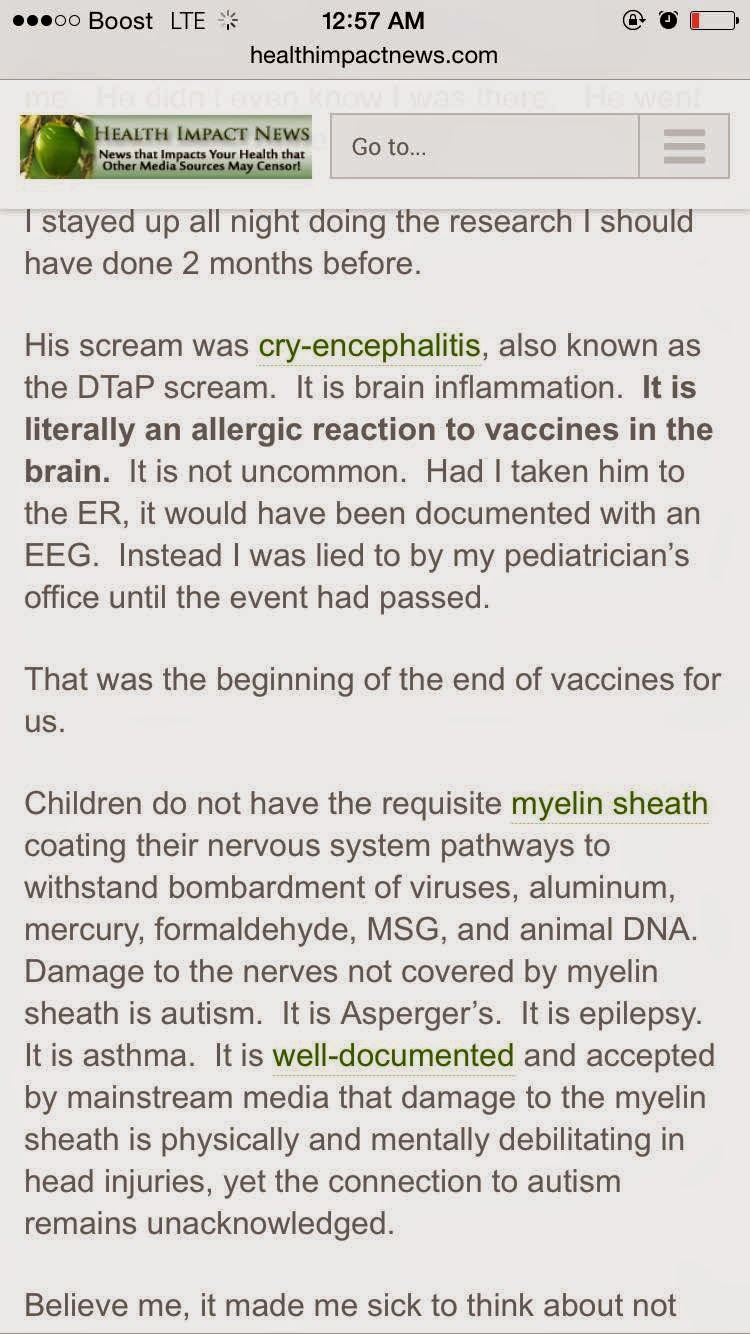
Again and again and again, anti-vaccine activists claim that their doctors are involved in fraud or cover-up. When they diagnose their children with lead and mercury poisoning, and the doctors say that the bloodwork doesn't show it, they seek the aid of labs that willfully falsify test results-- enablers of Munchausen by proxy. When they diagnose their own children with encephalitis and their doctors say that crying after a vaccine is normal and not a sign of brain inflammation, they spread conspiracy theories about cover-ups-- neverminding, of course, that children with untreated encephalitis invariably die. When they diagnose their own children with vague food allergies and insensitivities, restricting their diets to the point of causing severe malnutrition, they insist that doctors just "don't know" and that their claims as parents matter more than the results of diagnostic tests.

I would be writing this post for weeks straight if I found all the accounts that sound like Munchausen by proxy by anti-vaccine activists, but here are just a few screencaps of just a few of them.


The thing that's crystal-clear is that the most prominent members of the anti-vaccine movement show all the most worrisome signs of Munchausen by proxy. Their children tend to suffer from vague symptoms that can not be explained through medicine or science. They diagnose their own children with conditions that doctors say they don't have. They put their children through experimental treatments that are condemned by mainstream medical experts. They hop from one "expert" to another when caregivers begin to notice signs that the parents may be responsible for the illness. The scariest thing is that many of them are successful not only in abusing their own children, but also in convincing others to do the same. Anti-vaccine forums have largely become support groups for people with Munchausen by proxy who are helping each other maintain abuse without prosecution or accountability. It's dangerous and it's deadly.

I have two very happy, healthy children. I am grateful for that every single day. My oldest has autism, but I not only don't consider that to be a disease, but her form of autism would be impossible to "condition" or create. There is no way to condition a six-month-old to have gross motor delays or to condition a two-year-old to have echolalia, or to condition a five-year-old to write entire pages of text in perfect mirror-image. These traits are not the result of my conditioning, but of a unique and beautiful neurology that I joyfully accept and embrace. If you could possibly accuse me of having Munchausen by proxy, it might be time to check and make sure that you're not in fact looking into a mirror.

Extremist Natural Parenting Creates Horrible, Unhappy Children


(Stock image- this is NOT one of the children discussed in this post.)


When I was eighteen, I met a family that at first seemed to be exactly who I wanted to be one day. They were radical, natural-living parents with three kids who spent their days picking berries and playing outside. At the time, they were eight, seven, and four years old, and they seemed like the happiest family I could imagine. For the sake of protecting their privacy, we’ll call the kids A, B, and C.

I was thrilled. I told the parents all about my aspirations to be a mother one day and to do all the things they were doing: natural birthing, alternative medicine, cloth diapering, homeschooling, gentle discipline. I even told the mother that she was exactly the kind of mom I hoped to be one day. And at the time, I meant it.

Much to my excitement, they hired me as their babysitter… and I found out what radical “natural” parenting is really like, in all its horrors. To be clear: there is nothing wrong with gentle discipline. There is nothing wrong with homeschooling. There is nothing wrong with green living. These are all choices that I whole-heartedly support. But what this family did was so extreme that it rocked my world, and, luckily, taught me a thing or two about how not to parent.

The first time I babysat for them, I was eager to read books to them. But, for a homeschooling family, they had very few—maybe fifteen altogether. Worse: the kids not only couldn’t read the books, but the older two, at seven and eight years old, barely knew how to identify any letters at all.

“Do your parents not read to you?”

“Sometimes,” B explained with the severe speech impediment she shared with her two siblings, “But they think it’s better for us to see the real world.”

“I don’t like the real world,” A said sharply, “I like video games.”

“Oh?” I was a little surprised. Too natural for books but they played video games, “Your parents don't have rules about video games?"

“We don’t really ave rules.”

“You don’t have rules at all?”

“Mommy makes requests but we can choose whether or not to do what she asks.”

I tilted my head a little to the side. That seemed strange to me, but then again, these people were over a decade older than me and seemed to know what they were doing. They were confident in their parenting skills, and if it was working, it was working, right?

The next time I babysat for them, A played violent video games the whole time. Because he couldn’t read, he kept demanding that I read the dialogue to him. When I reminded him to say please and thank you, he refused and threw the controller at me. I told him he wasn’t allowed to play any more video games until his mother came back—a decision that triggered a wild, flailing, screaming tantrum on his part. He told me that he hated me and called me a “mother*cking b*tch”—this from an eight-year-old, mind you-- and told me to go “f*ck” myself. His little brother and sister cowered in a corner, looking like they had seen this many times before.

When his parents came home, I was shaking and explained to them what happened. They shrugged as if I had told them he’d eaten too many cookies and said that “He’s like that sometimes.”

Then they blew my mind by telling me not to ever use punishments like that again.

“In our family, we operate by consensus and compassion,” the mom sanctimoniously explained, “We don’t tell people to do anything; we ask them nicely. If they don’t do it, they have that choice.”

“So what about when he doesn’t obey me?” I asked, incredulous.

“He doesn’t have to.”

“So when I ask him to say please and he refuses…?”

"He doesn't have to."

"And if he curses at me again?"

“It’s his choice in how he communicates.”

She pointed to a print-out on the wall from a gentle-parenting website and told me to read it to her kids whenever I was asking them to do something. I can’t remember it verbatim, but it said something like, “I want you to do this only if you can do it with the joy of a child feeding ducks. I don’t want you to do this because you fear me or because you think I you will disappoint me."

The next time I babysat for the family, I found myself reading and reciting the line over and over, to no avail. The pattern continued: A had tantrums, B was afraid, and C obliviously played with little toddler-toys and didn’t seem to notice the state of turmoil in the family.

One day, C was crying inconsolably the entire time I was there. He kept pointing to his genitals and crying, “Ouch!” I asked him if I could look and saw one of the most horrifying injuries I’ve ever seen—his scrotum bright-red and swollen to nearly the size of a softball, clearly infected. A and B informed me that four-year-old C had gotten a tick bite on his scrotum that had become infected, and their parents were treating it with homemade plantain-leaf salve.

When they came home, I brought my concerns to their attention, and, much to my relief, they took him to an actual pediatrician the next day and got him a prescription for antibiotics. I’d like to think that they would have done it even if no one had found out about their son’s infection, but I have a sinking feeling that they would have let the infection fester until it made him sterile or dead.

Eight-year-old A’s violent tantrums grew worse and worse, and eventually, at wit’s end, I finally said, “Look, your parents don’t believe in punishment, but I do. You are going to stop acting like this. You are going to sit down, behave yourself, and practice writing your name. Do you understand me?”

He screamed, “F*ck you!” to me and ran outside.

The next time I came over, I saw him sitting smugly on the couch with his arms crossed.

“I can’t let you past the door,” his mother said apologetically, “Because you’re not allowed here anymore.”

“Not allowed? What did I do?”

“Our family operates by consensus, and you don’t have A’s permission to be here anymore. B and C still like you a lot and want you to babysit, but A won’t allow you in the home so you’ll need to do it somewhere else if you’re still interested.”

I tried. I really tried. Because somehow, I had really started to love those kids. After a few months, I eventually taught B how to read short sentences—she was very smart and caught on quickly-- and I was playing fun make-believe games with C. I grew close with their father and tried to understand his parenting choices. I suspended disbelief and tried to convince myself that the parents knew what was right for their own kids. I had to make sense of it. It couldn't be as bad as it seemed, could it?

Then it got even more disturbing. I saw that their mother, completely covered in bruises. She looked like a stereotypical victim of domestic violence, but I knew her husband wasn't the one who did it.

"Are you okay?" I asked her quietly, feeling truly sorry for her. How awful, to be assaulted by your own child.

"I'm trying not to make a big deal about it," she said.

I had been biting my tongue for a long time, wanting to believe that this family knew more than me about parenting because they were older and more experienced, but I couldn’t hold my words in any longer.

“Your kids need help,” I told her, shaking.

“I already have a therapy appointment for A,” she conceded. I wondered what else she wanted to say. I wondered if her experiment in permissive parenting had ended and if she had finally concluded that she had messed up, terribly, and that her kids were hurt because of it.

About five years ago, I spoke to someone who knew the family and I was disturbed, but not surprised, by what I found out. B had desperately wanted to go to school and was enrolled in public school that year—that was the good news—and her little brother C ended up coming along. After hearing how much fun they were having, A asked to attend school, too, where he was quickly expelled for his frequent violent behavior. B and C were doing okay, but A had become so dangerous and volatile—a threat to his parents, his peers, and his siblings—that his parents were struggling to decide what to do with him.

I wish I had never met those children, not because they were “bad,” but because it absolutely broke my heart that their parents had made such reckless decisions in the name of “nature.” Their children were hurt by their negligence and dedication to a laissez-faire parenting attitude that eschews discipline and education in favor of allowing children to make their own rules.

A, B, and C are all teenagers and young adults. I think about them often, because they gave me an opportunity that I couldn’t have gotten from anywhere else. I learned how to care for kids because of them—and I learned how not to. They were difficult children, but they were still children, and they were children who I had ultimately loved deeply and completely.

Children deserve to be loved, and part of love is disciplining, not just “gently” and passively, but sometimes firmly and authoritatively. Children need guidance. Children need to sometimes be told, “No.” Children sometimes need to be punished. And children sometimes need to know that the world isn’t always going to care about their feelings or dignity, and that sometimes they have to do as they’re told because it’s what’s necessary.

Thank you, A, B, and C, for what you did. Thank you for letting me know you and love you. And above all else, thank you for showing me exactly how I don’t want to raise my own children.